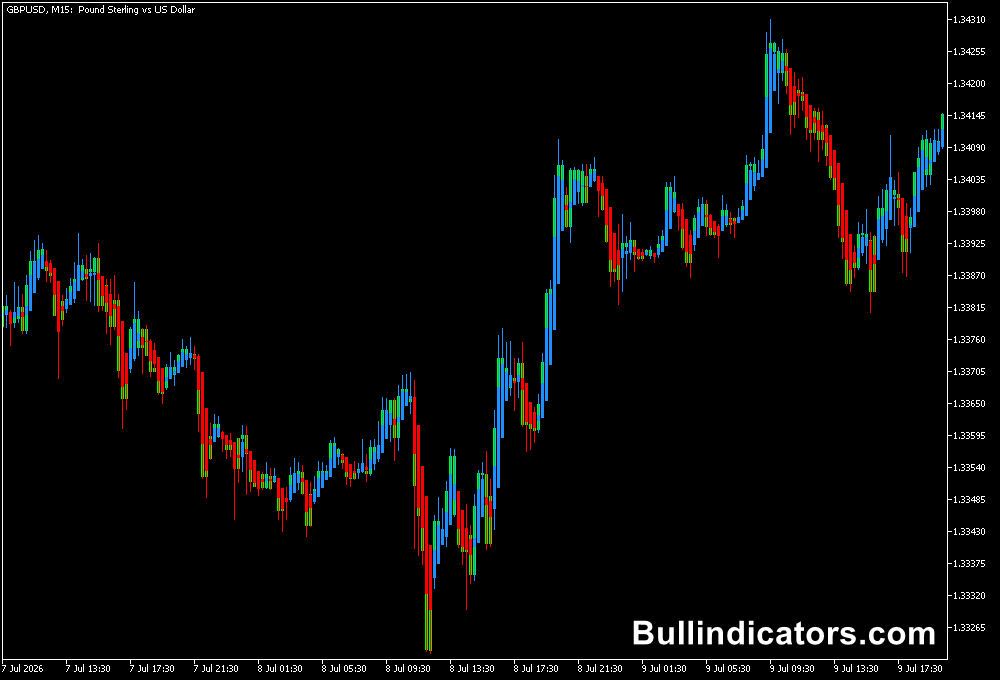
The Silver Trend Signal indicator for MT5 is a trend-following tool that displays bullish and bearish arrows as price direction changes.
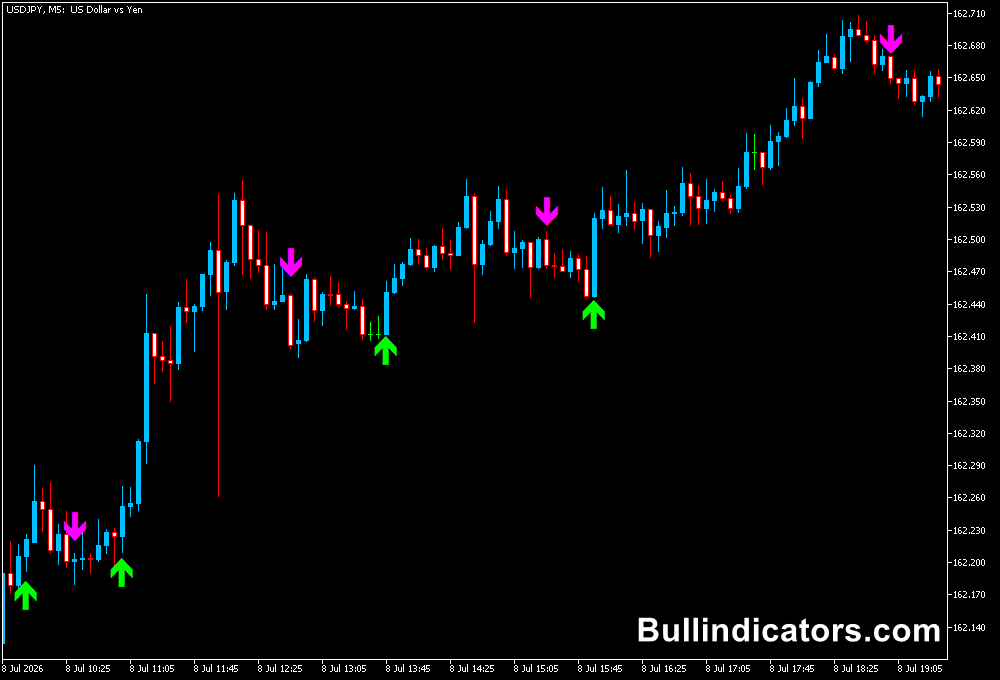
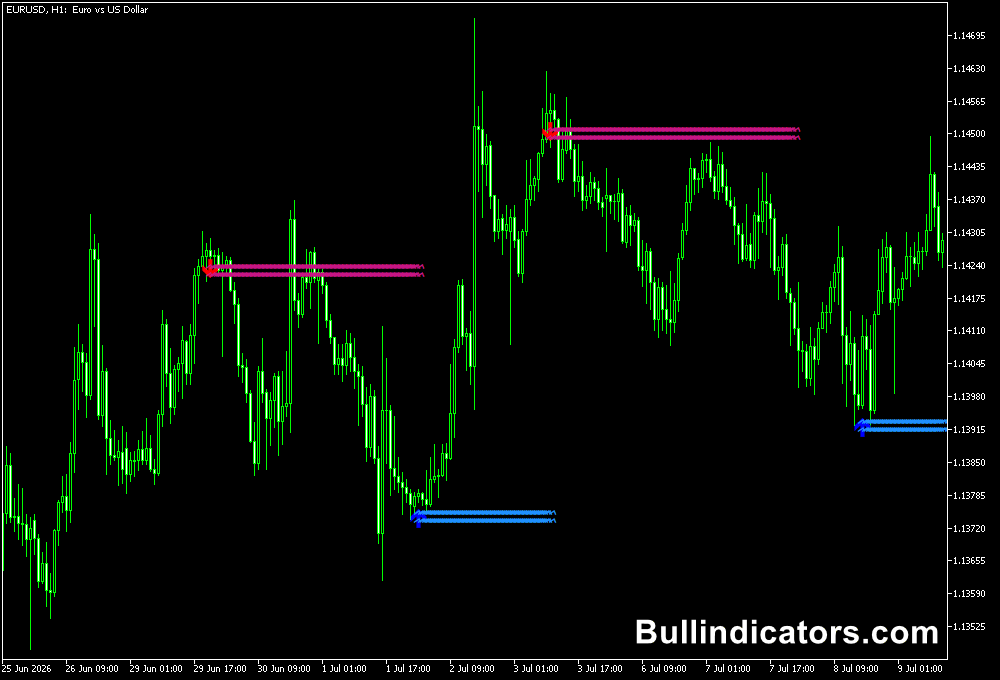
Blue arrows identify potential BUY opportunities, while magenta arrows point to possible SELL setups.
The simple visual approach makes it easy to monitor short-term movements and follow the prevailing direction of the market.
The indicator is particularly useful for scalping because it can provide clear directional signals on M1, M5, and M15 charts.
It can also be combined with another trend indicator to filter weaker setups.
One useful combination is the 3 Color MACD Indicator for MT5, where the MACD zero line can be used to determine whether the market has positive or negative trend momentum.
Why traders use the Silver Trend Signal Indicator
Following a trend becomes easier when the direction of a move can be identified quickly.
The Silver Trend Signal places arrows on the chart so users can react when bullish or bearish conditions develop.
For a simple confirmation method, the 3 Color MACD can be checked before taking an arrow signal.
When the MACD is above the zero line, it indicates positive trend conditions.
When the MACD is below zero, it indicates negative trend conditions.
A bullish Silver Trend Signal therefore has greater directional agreement when the MACD is above zero, while a bearish arrow is aligned with the trend when the MACD is below zero.
This combination can be especially useful for scalping, where many short-term signals can appear during a trading session.
Filtering the arrows according to the MACD direction can help focus attention on setups that agree with the prevailing momentum.
Download This MT5 Indicator for Free
Indicator Chart Setup
The indicator displays two main types of signals.
A blue upward arrow represents a BULLISH condition and can be used as a potential BUY signal.
A magenta downward arrow represents a BEARISH condition and can be considered as a potential SELL signal.
For a multi-timeframe approach, the higher timeframe can be used to establish the general market direction while the lower timeframe provides the entry signal.
For example, H1 can be monitored for the primary trend and M5 can be used to identify a short-term entry.
This approach can be particularly useful when scalping because it keeps lower-timeframe trades aligned with the larger price movement.
Core Features
- Blue BULLISH BUY arrows
- Magenta BEARISH SELL arrows
- Trend-following signal approach
- Adjustable RISK parameter
- Configurable alert quantity
- Suitable for scalping and intraday trading
- Can be combined with momentum and trend indicators
- Useful for manual trading and automated strategy development
Best for
- Forex scalping on M1/M5
- Short-term trend following
- M1, M5, and M15 trend trading for 5/15 pips
- Intraday setups
- Multi-timeframe analysis
- Arrow-based entry strategies
Best Markets
The Silver Trend Signal can be tested across major and cross currency pairs, particularly markets that offer sufficient intraday movement.
GBPJPY is well suited to short-term testing because its price can travel significant distances during active sessions.
EURUSD, GBPUSD, USDJPY, EURJPY, and USDCAD can also be considered for different trading conditions.
When scalping, it is worth comparing the indicator on several pairs because the frequency and quality of directional moves can change considerably between markets and trading sessions.
Trading Styles
Scalping is one of the main applications for the Silver Trend Signal.
M1 can provide frequent opportunities, while M5 offers a little more room for short-term price swings.
M15 can be used when fewer signals with larger intraday moves are preferred.
For day trading, M15 and H1 can be combined, with the higher timeframe providing the directional context. H4 can also be monitored when the objective is to follow a larger trend and use lower timeframes for more favorable entries.
How traders use it
A straightforward method is to wait for a Silver Trend Signal arrow and then check the position of the 3 Color MACD relative to zero.
A blue arrow accompanied by a MACD above zero provides bullish confirmation.
A magenta arrow with the MACD below zero provides bearish confirmation.
GBPJPY BUY Example
Imagine GBPJPY trading on M5 after moving higher during an active session.
The 3 Color MACD is above the zero line, indicating positive trend momentum.
Price makes a small pullback and then the Silver Trend Signal produces a blue bullish arrow around 201.20.
A BUY entry near 201.20 would have both signals pointing upward.
A recent swing low could be used as the stop-loss reference.
If GBPJPY continues higher and reaches 201.55, the move represents a 35-pip gain.
The position could then be managed by following subsequent price action or waiting for a bearish Silver Trend Signal to appear.
GBPJPY SELL Example
Now consider the opposite situation.
GBPJPY is trading near 201.80 and begins to lose upward momentum.
The 3 Color MACD is below the zero line, showing negative trend conditions.
A magenta Silver Trend Signal arrow then appears around 201.80 after price fails to continue higher.
A SELL entry around 201.80 would have confirmation from both the arrow and the MACD direction.
A recent M5 swing high could be used to determine the stop-loss location.
If GBPJPY declines to 201.45, the position has gained 35 pips. The trade can then be managed while the bearish arrow signals and MACD remain aligned.
These GBPJPY examples are illustrative setups rather than historical performance results.
The objective is to demonstrate how the two indicators can work together: the Silver Trend Signal identifies the entry direction, while the MACD position relative to the zero line provides trend confirmation.
Get Instant Free Access
Indicator Settings
- RISK: Increasing the value produces smoother BUY and SELL arrow signals. Higher settings can reduce signal frequency while emphasizing larger directional movements.
- Number of Alerts: Controls the indicator’s alert signals and their quantity.
Important Notes
- The arrows should be treated as potential trading signals and not guaranteed entry points.
- Checking the higher timeframe can provide useful context before entering a lower-timeframe trade.
- For scalping, testing different currency pairs and sessions can help identify where the indicator fits the trading approach.
- A MACD reading above zero indicates positive trend conditions, while a reading below zero indicates negative trend conditions.
- Using a confirmation indicator can help filter signals that conflict with the prevailing market direction.
- Stop-loss placement should account for recent swing levels and the volatility of the selected currency pair.
- The RISK setting can be adjusted according to whether more frequent or smoother signals are preferred.