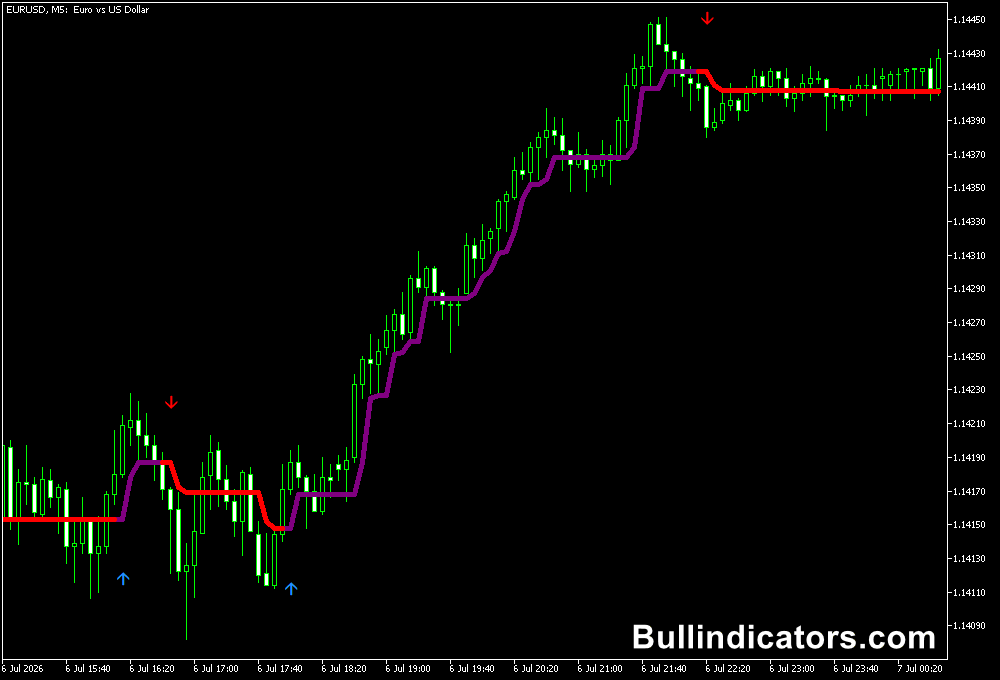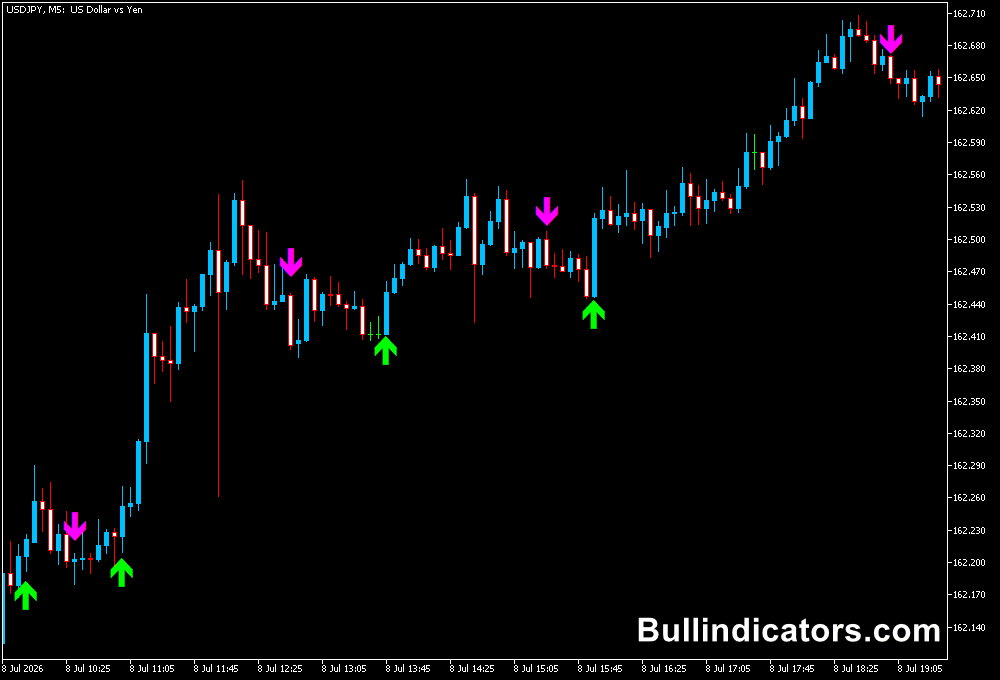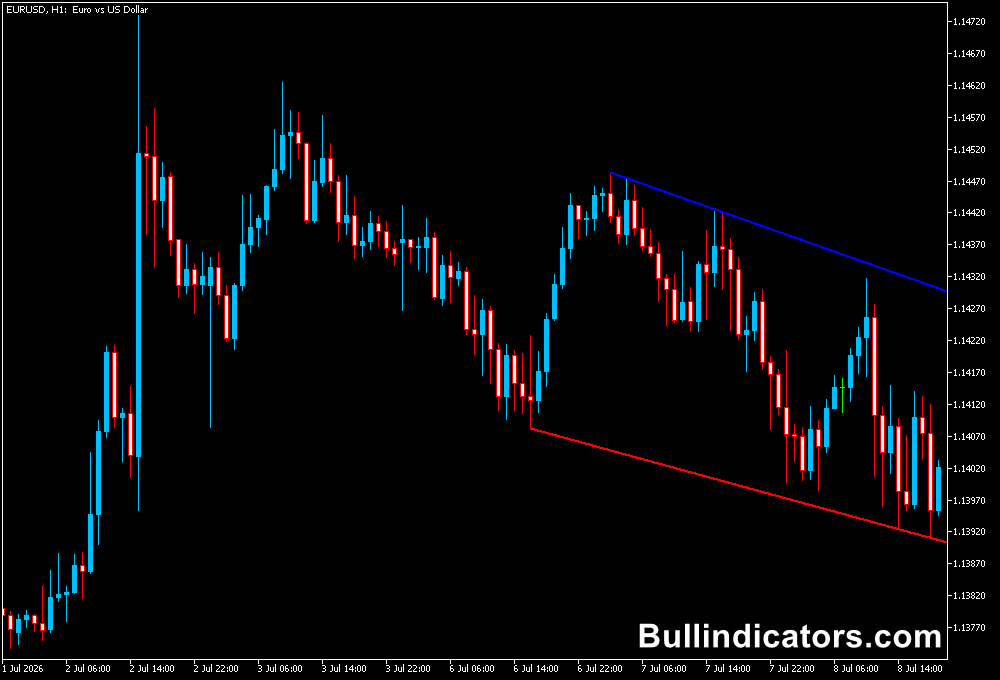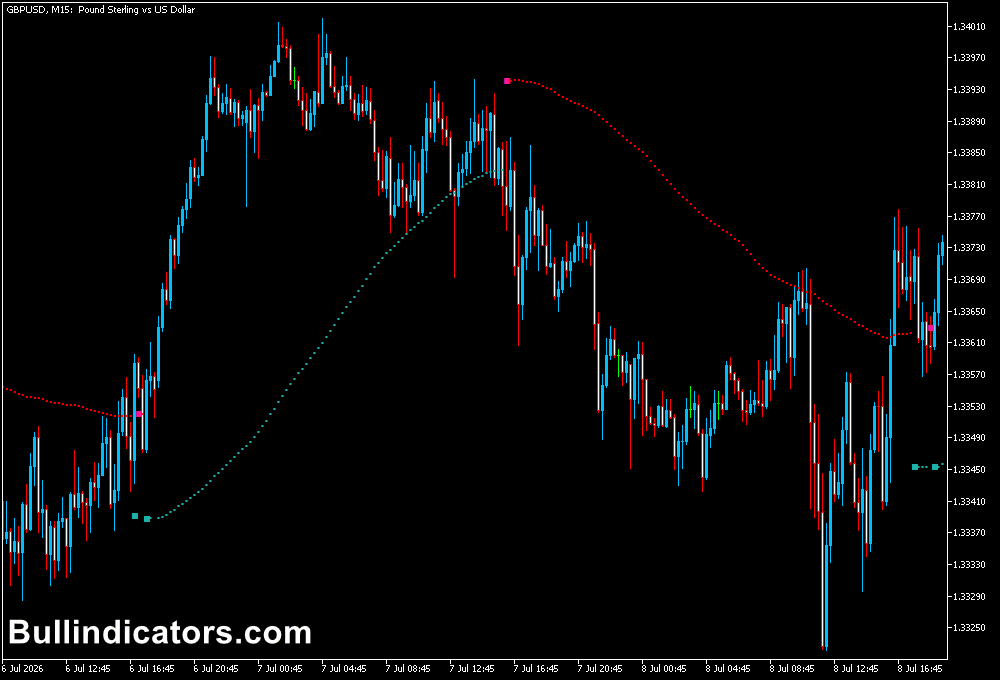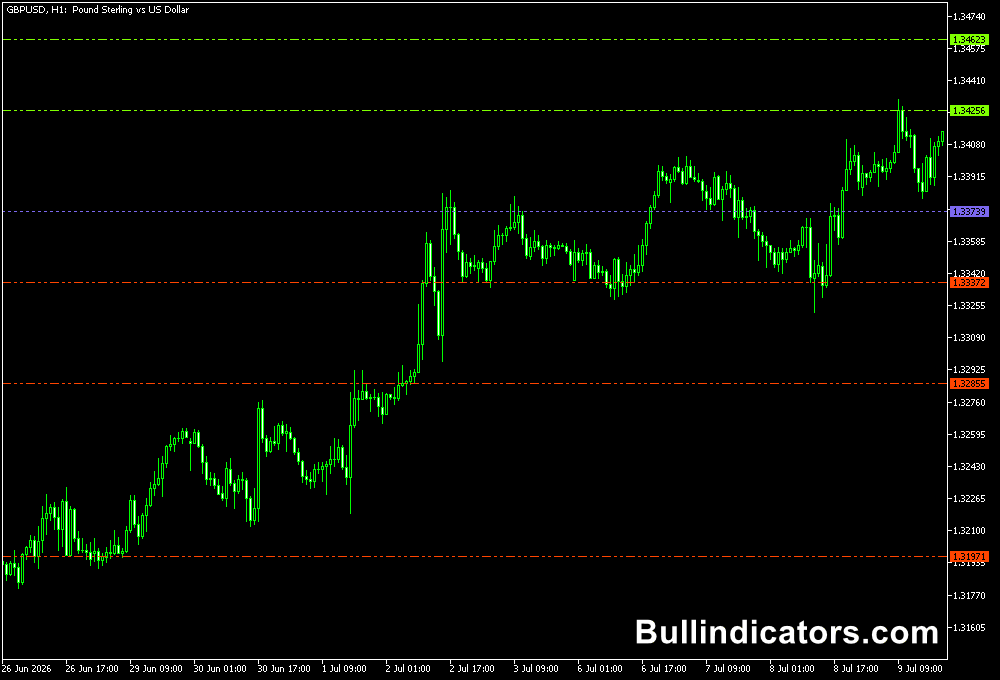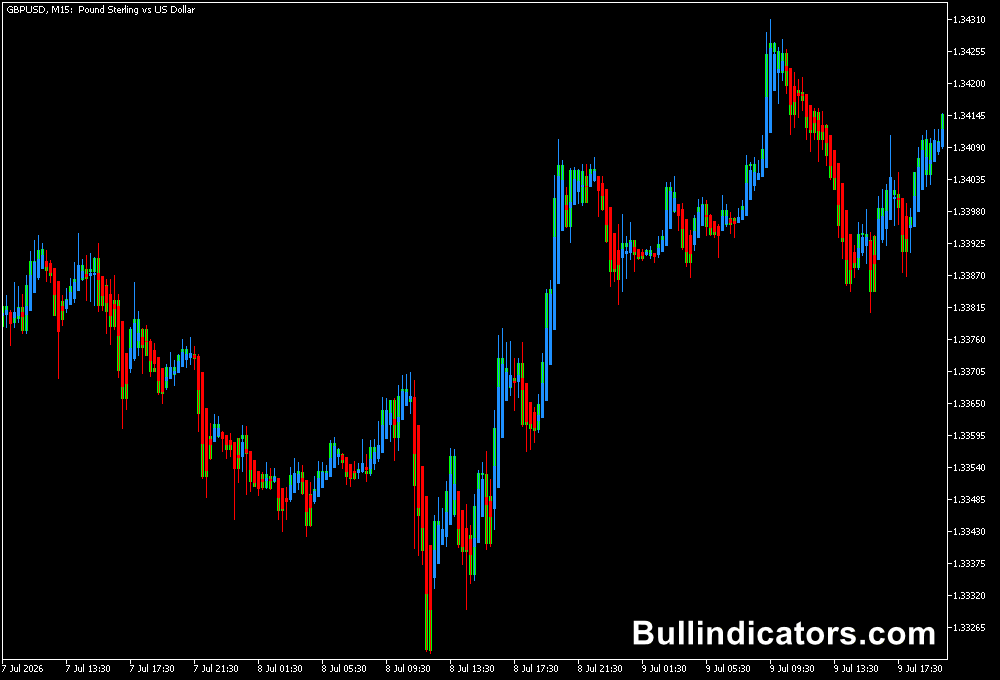
The 3 MA Cross Alert indicator for MT5 is a multi-timeframe trend moving average tool that combines three exponential moving averages to identify changes in market direction.
The indicator uses fast, medium and slow EMAs and marks important crossover events directly on the price chart.
When the moving averages produce a bullish or bearish crossover, the indicator displays a colored arrow and diamond.
This gives a straightforward way to monitor momentum changes without manually comparing several moving averages.
Because the indicator can work across multiple timeframes, it can also be used for short-term scalping as well as intraday trend analysis.
Why traders use the 3 MA Cross Alert Indicator
Moving average crossovers are widely used for identifying potential trend transitions.
The 3 MA Cross Alert Indicator adds a third EMA and visual signal markers, allowing the relationship between short-, medium- and longer-term momentum to be assessed from one chart.
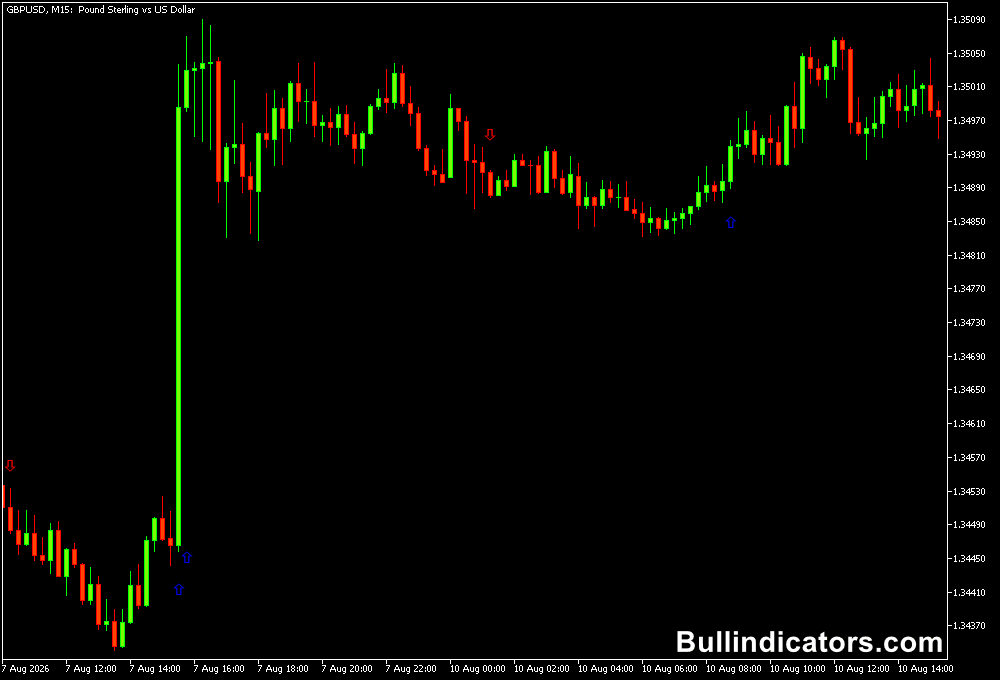
A blue arrow and diamond indicate a bullish crossover, while a red arrow and diamond identify bearish conditions.
The multi-timeframe functionality can also help with confirmation, particularly when a short-term setup agrees with the direction visible on a higher timeframe.
Download This MT5 Indicator for Free
Download “ma-cross-3-ma-cross-alert-warn-sig-indicator.ex5” Indicator
Indicator Chart Setup
After being added to a MetaTrader 5 chart, the indicator places three exponential moving averages over the price candles.
The lines represent fast, medium and slow market calculations, creating a visual picture of short-term momentum in relation to the broader price movement.
When a crossover occurs, an arrow and diamond appear on the chart.
A bullish crossover is marked with blue, while a bearish crossover is marked with red.
These markers make potential entry areas easier to locate, although the signal should be assessed together with price action and the prevailing market conditions.
Core Features
- Three exponential moving averages for trend and momentum analysis.
- Multi-timeframe functionality for broader market confirmation.
- Blue arrows and diamonds for bullish crossover signals.
- Red arrows and diamonds for bearish crossover signals.
- Adjustable MA periods and colors.
- Useful on both short-term and higher-timeframe charts.
Best for
- Identifying potential trend changes after EMA crossovers.
- Confirming short-term momentum before entering a position.
- Following established intraday trends.
- Filtering M1 and M5 setups with higher-timeframe direction.
- Monitoring bullish and bearish crossover zones without manually calculating moving averages.
Best Markets
- EURUSD and USDJPY are suitable for fast intraday signals because of their liquidity and generally tight spreads.
- GBPUSD can provide stronger M5 and M15 momentum during active London and New York sessions.
- Gold (XAUUSD) can be interesting for experienced short-term users, although its larger price swings require wider risk parameters.
- Major currency pairs with consistently low spreads are generally preferable for frequent crossover strategies.
Trading Styles
- M1 scalping: EURUSD, USDJPY and GBPUSD during liquid sessions.
- M5 momentum trading: GBPUSD and EURUSD when short-term momentum is strong.
- M15 intraday trading: use the crossover as a directional trigger alongside price action.
- H1 trend trading: monitor the relationship between the three EMAs for broader directional confirmation.
- Multi-timeframe trading: use H1 or M15 for direction and M1 or M5 for more precise entries.
How traders use it
A common approach is to wait for the three moving averages to show agreement before considering a position.
The crossover itself provides the trigger, while the position of price relative to the moving averages can help determine whether momentum supports the signal.
Bullish Setup
- Wait for the faster EMA to cross above the relevant slower EMA.
- Look for the blue arrow and diamond to confirm the bullish crossover.
- Prefer signals where price is also holding above the moving averages.
- For additional confirmation, check whether the higher timeframe is also pointing upward.
- A stop loss can be placed below a recent M1 swing low when scalping.
Bearish Setup
- Wait for the faster EMA to move below the slower EMA.
- Look for the red arrow and diamond to identify the bearish signal.
- Give preference to setups where price remains below the moving averages.
- Check the higher timeframe when market direction is uncertain.
- For an M1 short trade, a recent swing high can provide a logical reference for the stop loss.
Get Instant Free Access
Download “ma-cross-3-ma-cross-alert-warn-sig-indicator.ex5” for MT5
M1 Scalping Example
For M1 scalping, use the 3 MA Cross Alert Indicator on EURUSD or USDJPY during a liquid trading period.
A practical method is to first check the M15 chart for the dominant direction, then move to M1 and wait for a crossover that agrees with that bias.
- For a bullish M15 environment, wait for a blue M1 crossover after a brief pullback.
- Consider the long entry once the bullish signal is confirmed by price movement.
- Place the stop below the latest M1 swing low rather than using an arbitrary distance.
- For bearish conditions, wait for a red M1 crossover following a retracement toward the moving averages.
- Avoid taking every crossover when the three EMAs are repeatedly crossing in a narrow range.
- Keep spread and execution costs in mind because M1 targets are relatively small.
Indicator Settings
- Periods – controls the periods used by the moving averages.
- Colors – controls the visual colors used by the indicator and its signals.
Important Notes
- Moving average crossovers are reactive signals and can appear after a portion of a move has already developed.
- Sideways markets can generate multiple crossover signals with limited follow-through.
- Higher-timeframe confirmation can help reduce low-quality short-term signals.
- For M1 scalping, low spreads and fast execution are particularly important.
- Risk should be based on the current market volatility and recent price structure rather than a fixed number of points.