The MACD True indicator for MT4 is a momentum and trend-following tool designed to measure the relationship between a fast and slow moving average.
It combines the traditional MACD approach with a signal line and histogram, giving you several ways to evaluate momentum, direction and potential changes in trend.
The indicator can be used for both entry and exit decisions.
The interaction between the MACD and signal line provides the primary crossover signals, while the histogram helps assess whether momentum is strengthening or fading.
This makes it useful across scalping, intraday and swing trading strategies.
Why traders use the MACD True Indicator
MACD is widely used because it combines trend and momentum analysis in one calculation.
The MACD True Indicator follows the traditional 12, 26 and 9 configuration by default, while allowing these values to be adjusted to suit different markets and trading styles.
A crossover above the signal line can indicate increasing bullish momentum, while a crossover below it can indicate growing bearish pressure.
The position relative to the zero line adds another layer of trend confirmation.
The histogram is also valuable. Longer bars indicate stronger momentum, while shrinking bars can warn that the current move is losing strength.
This can help with both trade selection and exit management.
Download This MT4 Indicator for Free
Indicator Chart Setup
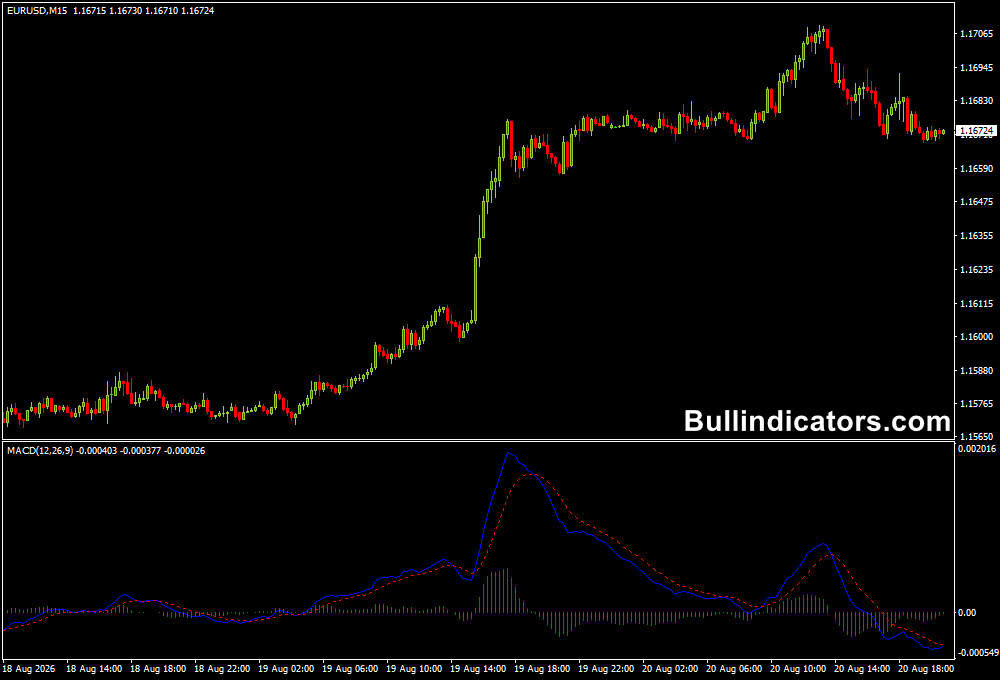
The MACD True Indicator is displayed in a separate window below the MT4 price chart.
It shows the MACD calculation together with its signal line and histogram, allowing you to compare momentum with the underlying price movement.
The zero line is particularly useful when filtering signals.
Bullish crossovers above zero generally provide stronger trend confirmation, while bearish crossovers below zero can offer better alignment with downside momentum.
Core Features
- Traditional MACD-based momentum analysis.
- Fast and slow moving-average calculations.
- Additional signal line for crossover analysis.
- Histogram for measuring momentum strength.
- Zero-line trend confirmation.
- Adjustable MACD parameters.
- Suitable for scalping, intraday and swing trading.
Best for
- Identifying momentum shifts.
- Confirming trend direction.
- MACD crossover strategies.
- Trend continuation entries.
- Spotting weakening momentum before an exit.
- Combining momentum with price-action setups.
Best Markets
- EURUSD — well suited to MACD-based intraday strategies because of its liquidity and typically tight spreads.
- GBPJPY — useful when stronger momentum develops during London and New York sessions.
- USDJPY — suitable for trend-following setups during active market periods.
- AUDUSD — can produce useful momentum swings during Asian and London sessions.
- USDCAD — particularly interesting around the North American session when directional movement increases.
- Gold (XAUUSD) — suitable for experienced users who understand its higher volatility and larger price swings.
Trading Styles
- Scalping on M1 and M5.
- Intraday momentum trading on M15 and H1.
- Swing trading on H4 and D1.
- Trend continuation strategies.
- MACD crossover systems.
How traders use it
A professional approach is to avoid treating every crossover as an automatic trade.
The quality of a MACD signal depends heavily on the surrounding market conditions.
Crossovers aligned with the broader trend generally deserve more attention than signals appearing in a sideways market.
Buy and sell setup explained
For a BUY setup, look for the MACD to cross above its signal line while preferably holding above the zero line.
Increasing histogram bars can provide additional evidence that bullish momentum is expanding.
A nearby support level or bullish price-action formation can further strengthen the setup.
For a SELL setup, look for the MACD to cross below the signal line while preferably remaining below zero.
Expanding bearish histogram bars indicate that downside momentum is increasing. Resistance or a bearish price-action formation can provide additional confirmation.
EURUSD M15 trade example
For example, on EURUSD M15, you could first establish the H1 trend and then use the M15 MACD True crossover to time an entry.
If H1 is bullish and the M15 MACD crosses above its signal line with the histogram expanding, a BUY setup is more attractive than taking a countertrend SELL.
A stop can be positioned below the latest M15 swing low, with the first target around a previous resistance level.
Buy Rules
- Identify a bullish trend on the higher timeframe.
- Wait for the MACD to cross above its signal line.
- Prefer the crossover to occur above the zero line for stronger trend alignment.
- Look for the histogram to expand with bullish momentum.
- Confirm the setup with support, a breakout or bullish price action.
- Enter BUY after confirmation.
- Place the stop below a recent swing low or relevant support zone.
- Target the next resistance area or use a suitable risk-to-reward ratio.
Sell Rules
- Establish bearish direction on the higher timeframe.
- Wait for the MACD to cross below its signal line.
- Prefer the crossover to occur below the zero line.
- Check for expanding bearish histogram bars.
- Confirm with resistance, a downside breakout or bearish price action.
- Enter SELL after confirmation.
- Place the stop above the latest swing high or resistance area.
- Use the next support zone or a predefined risk-to-reward target for profit taking.
Get Instant Free Access
Indicator Settings
- Fast MA Period: The fast moving-average calculation. The default setting is 12, but it can be changed for faster or slower responses.
- Slow MA Period: The slower moving-average calculation. The default is 26 and can be adjusted according to the market and timeframe.
- Signal MA Period: Controls the signal line used for MACD crossovers. The default is 9, although this can be changed to make signals more responsive or smoother.
Important Notes
- MACD crossovers can produce false signals when the market is moving sideways.
- Higher-timeframe direction can help filter countertrend setups.
- Histogram expansion provides useful information about momentum, but should not be used as the sole entry trigger.
- Different currency pairs can respond differently to the same MACD parameters.
- The default 12, 26 and 9 settings are a starting point rather than a requirement.
- Gold and other volatile instruments generally require more room for stops than major Forex pairs.
- For scalping, pay close attention to spreads and session liquidity because transaction costs have a greater impact on small targets.