The Currency Strength Index indicator for MT5 compares the relative strength of eight major currencies: EUR, GBP, AUD, NZD, USD, CAD, CHF, and JPY.
It displays each currency as a colored line in a separate chart window, using a scale from 0 to 100.
Readings near 100 indicate relative strength, values near zero suggest weakness, and readings around 50 indicate more balanced conditions.
For day trading, the indicator helps identify currency pairs with a clear strength difference.
For example, a strong AUD and weak USD may make AUDUSD worth investigating for buying opportunities.
Why Traders Use the Currency Strength Index Indicator
Choosing currency pairs with clear directional potential can be challenging.
The Currency Strength Index makes comparisons easier by displaying the performance of several currencies in one window.
If GBP and AUD are strong while USD and JPY are weak, you can investigate pairs such as GBPUSD, AUDUSD, and GBPJPY.
The readings provide directional context, while price action helps determine whether an entry is justified.
Currency strength can change throughout the trading day.
Monitoring the lines during the London and New York sessions can help identify shifts in relative demand and potential intraday opportunities.
Download This MT5 Indicator for Free
Indicator Chart Setup
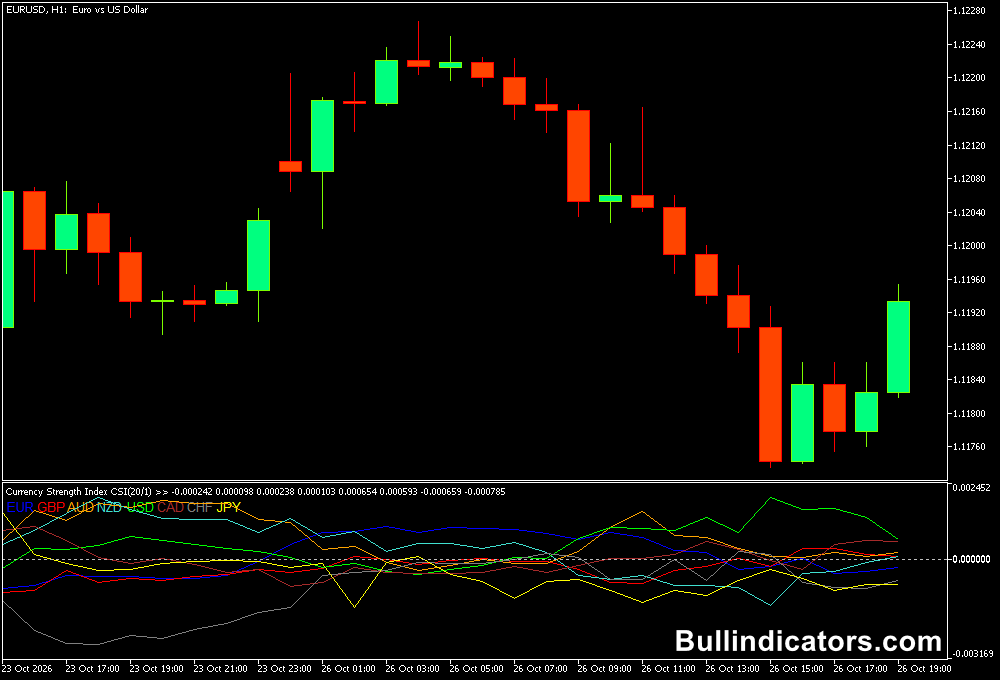
The indicator displays eight colored lines in a separate window, with matching currency ticker symbols in the upper-left corner.
The vertical scale runs from 0 to 100, making it easy to compare relative strength.
The distance between two lines is particularly useful.
A large gap between EUR and USD, for example, indicates a greater strength difference than readings that are close together.
You can also enable or disable individual currencies to simplify the display around the pairs you trade most frequently.
Core Features
- Measures the relative strength of eight major currencies.
- Displays colored strength lines on a 0–100 scale.
- Highlights differences between stronger and weaker currencies.
- Includes adjustable calculation and smoothing parameters.
- Allows individual currencies to be enabled or disabled.
- Updates readings as market data changes.
Best For
- Finding relatively strong and weak currencies.
- Selecting pairs with noticeable strength differences.
- Monitoring changing currency demand during trading sessions.
- Filtering potential setups before technical analysis.
Best Markets
- EURUSD: Compare euro and US dollar strength.
- GBPJPY: Monitor pound and yen differences during London and Asian sessions.
- AUDUSD: Assess Australian dollar strength against the US dollar.
- USDCHF: Compare dollar and Swiss franc performance.
- EURGBP: Examine relative euro and pound strength.
- NZDJPY: Evaluate New Zealand dollar and yen strength.
Trading Styles
- Day trading: Use M15 and M30 charts to find directional differences during London and New York sessions.
- Scalping: Monitor M1 and M5 charts alongside price action.
- Intraday trend following: Use H1 charts to assess strength over several hours.
- Swing trading: Analyze H4 charts for longer-lasting differences.
How Traders Use the Currency Strength Index Indicator
The indicator does not generate direct buy or sell signals. Its purpose is to identify relatively strong and weak currencies so you can select pairs for further analysis.
Compare the strongest currency with the weakest one, then examine the relevant price chart for a breakout, pullback, or reversal pattern before considering an entry.
Day Trading Example: Finding Strong and Weak Currency Pairs
Imagine the following hypothetical readings during the London session:
- AUD: 82 – Strong.
- EUR: 68 – Relatively strong.
- GBP: 55 – Moderate strength.
- USD: 28 – Weak.
- JPY: 19 – Very weak.
These readings make AUDUSD, EURUSD, and GBPJPY worth investigating.
Confirm the potential direction on each price chart rather than entering solely on the strength values.
Buy Entry Example
- Currency selection: AUD is strong while USD is weak.
- Pair: Analyze AUDUSD on M15.
- Confirmation: Look for a resistance breakout or bullish pullback.
- Entry: Consider buying after price confirms the move.
- Stop-loss: Place it below a recent swing low or another valid invalidation level.
- Take-profit: Target the next resistance area or use a predefined risk-to-reward ratio.
Sell Entry Example
- Currency selection: GBP is weak while JPY is relatively strong.
- Pair: Analyze GBPJPY on M15.
- Confirmation: Look for a bearish breakdown or rejection from resistance.
- Entry: Consider selling after price confirms the downward move.
- Stop-loss: Place it above a recent swing high or another valid invalidation level.
- Take-profit: Target the next support area or use a predefined risk-to-reward ratio.
Check whether the strength difference persists, especially around economic announcements and central bank decisions.
Relative strength can change quickly and does not guarantee future price direction.
Get Instant Free Access
Indicator Settings
- MA Period: Sets the calculation period used to measure currency strength.
- MA Delta: Controls smoothing. Higher values can make readings less reactive, while lower values respond more quickly to changes.
- ShowEUR: Enables or disables the euro line.
- ShowGBP: Enables or disables the British pound line.
- ShowAUD: Enables or disables the Australian dollar line.
- ShowNZD: Enables or disables the New Zealand dollar line.
- ShowUSD: Enables or disables the US dollar line.
- ShowCAD: Enables or disables the Canadian dollar line.
- ShowCHF: Enables or disables the Swiss franc line.
- ShowJPY: Enables or disables the Japanese yen line.
Important Notes
- The indicator measures relative strength; it does not provide direct entry or exit signals.
- Readings near 100 indicate strength, while readings near zero indicate weakness. Values around 50 suggest balanced conditions.
- Use price action, support and resistance, or trend analysis to confirm potential entries.
- Higher timeframes can reduce short-term noise, while M5 and M15 charts offer more opportunities but may produce less reliable setups.
- A strong currency reading does not guarantee that every pair containing that currency will move in the expected direction.