The QQE Indicator for MT4 (Qualitative Quantitative Estimation) is a momentum and trend indicator built around the Relative Strength Index (RSI).
By applying advanced smoothing to the RSI, it produces cleaner signals while filtering out much of the market noise that affects traditional momentum indicators.
The QQE helps traders identify trend direction, momentum shifts, overbought and oversold conditions, and potential divergences, making it a versatile addition to both standalone and confirmation-based trading strategies.
Why traders use the QQE Indicator
Traders use the QQE Indicator because it provides reliable momentum analysis without the excessive lag found in many oscillators.
The smoothed RSI line reacts quickly to price movement while remaining stable enough to reduce false signals during normal market fluctuations.
The indicator can be applied in several ways.
Many traders use the 50 level as a trend filter, buying when the QQE remains above it and selling when it stays below.
Others focus on crossovers between the main QQE line and its trailing line to identify changes in momentum.
The overbought and oversold zones also help traders spot potential reversal areas, while divergence analysis offers additional confirmation before major price turns.
Download This MT4 Indicator for Free
Indicator Chart Setup
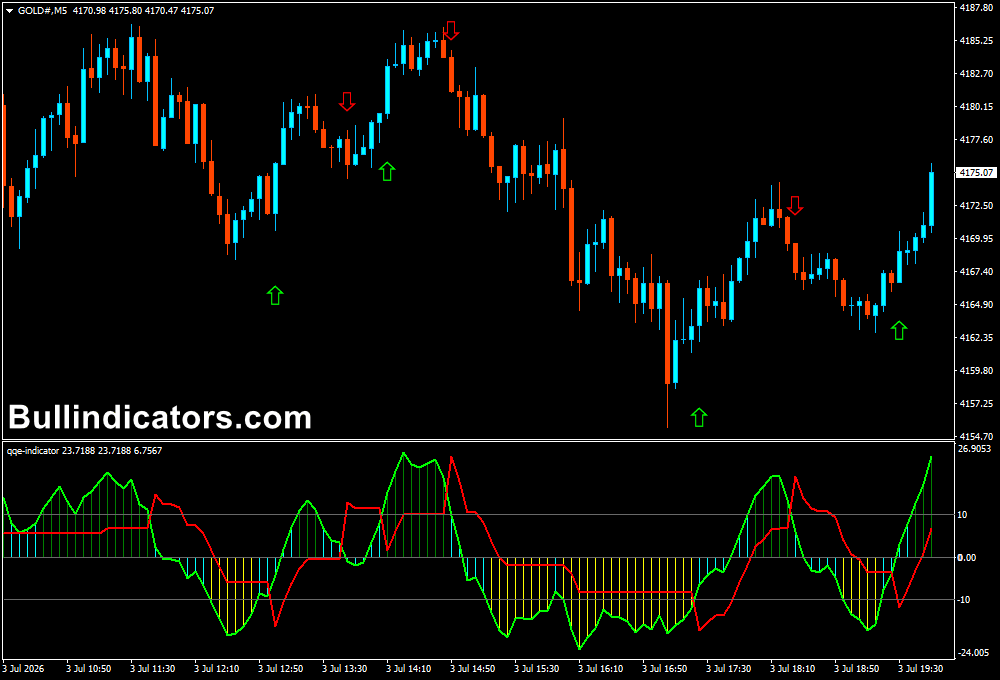
Once applied to a MetaTrader 4 chart, the QQE Indicator appears beneath the main price area.
The smoothed RSI line moves alongside a trailing signal line, allowing traders to monitor momentum changes through line crossovers.
Horizontal reference levels help identify bullish and bearish conditions, while the upper and lower boundaries highlight possible overbought and oversold zones.
Buy and sell signals become easier to recognize as momentum shifts develop.
Core Features
- Smoothed RSI calculation for clearer momentum analysis
- Trend identification using the 50-level
- Main line and trailing line crossover signals
- Overbought and oversold detection
- Divergence identification for potential reversals
- Configurable trading alerts
Best for
- Trend confirmation
- Momentum analysis
- Reversal trading
- Divergence confirmation
- Filtering trade entries
Best Markets
- Major Forex pairs such as EUR/USD, GBP/USD, and USD/JPY
- Minor and cross currency pairs with strong trends
- Gold (XAU/USD) and Silver (XAG/USD)
- Major stock indices during active sessions
- Highly liquid CFD markets
Trading Styles
- Scalping
- Day trading
- Swing trading
- Trend following
- Momentum trading
How traders use it
Many traders begin by determining the overall trend with the 50 level.
Long trades are favored when the QQE remains above 50, while short trades are considered below this level.
Entry timing is often refined by waiting for the smoothed RSI line to cross above the trailing line for a BUY setup or below it for a SELL setup.
Some traders also look for bullish or bearish divergence between price and the QQE to anticipate trend reversals before they become obvious on the chart.
A common combination is the QQE Indicator with a 100 EMA.
Traders only take BUY signals when both the QQE crossover and price are above the moving average, while SELL signals are traded below the 100 EMA.
This simple filter helps eliminate many trades that go against the dominant trend.
Get Instant Free Access
Indicator Settings
- SF: Sets the smoothing factor applied to the RSI calculation.
- RSI Period: Defines the number of candles used to calculate the RSI.
- WP: Controls the trailing line calculation used for momentum confirmation.
- Upper Bound: Specifies the overbought reference level.
- Lower Bound: Specifies the oversold reference level.
- Alerts ON: Enables or disables indicator alerts.
- Alerts on Zero Cross: Sends alerts when the indicator crosses the zero reference level.
- Alerts Push: Delivers notifications to the MetaTrader mobile app.
- Alerts Email: Sends email notifications for new signals.
- Colors: Customizes the appearance of the indicator lines.
Important Notes
- Use the 50 level to identify the prevailing market trend.
- Line crossovers are generally more reliable when they occur in the direction of the main trend.
- Divergence signals should be confirmed with price action before entering a trade.
- The indicator performs well across multiple timeframes.
- Always combine the QQE with sound risk management and position sizing.