The Asian Range indicator for MT5 automatically marks the high and low of the Asian trading session with a colored range on the chart.
This gives intraday Forex traders a defined consolidation zone to monitor before the more active London and New York sessions begin.
Asian trading hours can produce relatively contained price movement in many currency pairs.
As European liquidity enters the market, price frequently expands beyond this earlier range.
The Asian Range indicator provides a simple way to identify those boundaries without manually marking the session high and low each day.
The indicator is particularly useful for breakout strategies on GBP pairs, where increased volatility during the London session can produce sizeable moves after the Asian range has formed.
Why traders use the Asian Range Indicator
The main advantage of the indicator is that it turns the Asian session into a measurable trading zone.
The upper boundary represents the session high, while the lower boundary represents the session low.
Once London opens, these levels can be monitored for a breakout, retest or rejection.
GBP pairs are especially interesting for this strategy because they can experience strong volatility when European markets become active.
GBPUSD, GBPJPY and EURGBP can therefore provide attractive opportunities when price leaves a narrow Asian range.
The indicator can also be combined with price action, support and resistance, or a retest strategy.
A breakout followed by a successful retest of the range boundary can provide more confirmation than entering immediately on the first price spike.
Download This MT5 Indicator for Free
Indicator Chart Setup
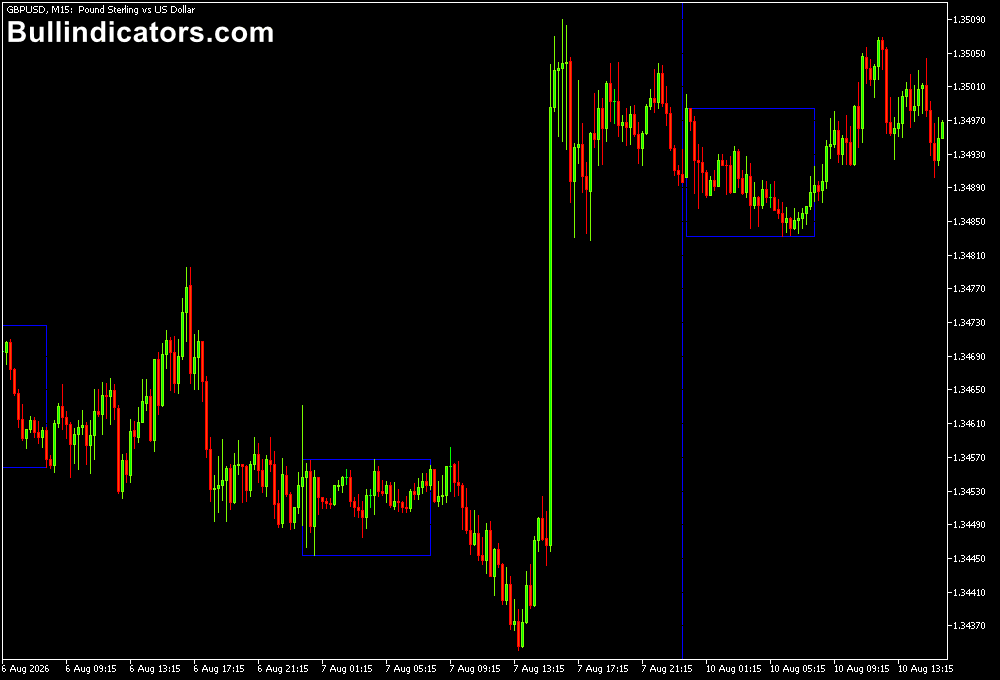
After the Asian session is defined, the indicator draws a colored rectangle around its trading range.
The upper edge represents the Asian session high and the lower edge represents the Asian session low.
The resulting box becomes a reference area for the next trading sessions.
A move above the upper boundary creates a potential bullish breakout, while a break below the lower boundary creates a potential bearish setup.
The range can also be used to identify where a breakout may fail and return into consolidation.
Core Features
- Automatically marks the Asian session high and low.
- Displays the Asian range as a colored chart rectangle.
- Identifies potential bullish and bearish breakout levels.
- Useful for London and New York session breakout strategies.
- Supports breakout and breakout-retest approaches.
- Adjustable session opening and closing times.
Best for
- Asian-session breakout trading.
- London open volatility strategies.
- Breakout-retest setups.
- Identifying daily consolidation zones.
- Short-term momentum trading after a range expansion.
Best Markets
- GBPJPY: One of the strongest candidates because London-session volatility can produce substantial moves after the Asian range.
- GBPUSD: Particularly suitable for London breakout strategies and intraday directional moves.
- EURJPY: Useful when the Asian range is followed by increased European-session activity.
- EURUSD: A liquid alternative for testing Asian-range breakouts around the London open.
- Other GBP crosses: Worth monitoring when the Asian range is relatively narrow and volatility increases as London becomes active.
Trading Styles
- M5 scalping: Use the range boundaries to identify fast London-session breakout and retest opportunities.
- M15 breakout trading: A strong choice for GBP pairs when price exits the Asian consolidation.
- H1 intraday trading: Use the Asian range as a broader reference for the day’s directional move.
- Breakout-retest trading: Wait for price to break the range and return to the broken boundary before considering an entry.
How traders use it
The basic bullish setup occurs when price breaks and closes above the Asian range high.
This indicates that buyers have pushed price beyond the consolidation established during the Asian session.
A bearish setup occurs when price breaks and closes below the range low.
For higher-quality setups, wait for the breakout to develop rather than reacting to the first intrabar spike.
A retest of the broken boundary can provide additional confirmation.
GBPJPY detailes trading example
For example, after GBPJPY breaks above the Asian high, price may return to that level, hold it as support and then resume upward.
This gives a more defined entry area and allows the recent swing low to be considered when placing the stop loss.
Consider a GBPUSD M15 example where the Asian range forms between 1.3420 and 1.3445.
During the London session, price closes above 1.3445 and then retests the level.
If the retest holds and a bullish candle develops, an entry around 1.3450 could be considered.
A stop loss might be placed below the retest low, for example at 1.3428, while the first profit target could be 1.3495.
The exact levels should always be adapted to current volatility and nearby support or resistance.
For a bearish setup, the process is reversed.
A break below the Asian low followed by a failed retest can provide a potential short entry, with the stop positioned above the relevant swing structure.
Get Instant Free Access
Indicator Settings
- Number of Days: Determines how many previous Asian ranges remain visible on the chart.
- Asian Session Open in local Time: Sets the local starting time used to calculate the Asian trading range.
- Asian Session Close in local Time: Sets the local ending time used to calculate the range.
Important Notes
- A break outside the Asian range does not automatically mean that price will continue in that direction.
- False breakouts are possible, particularly when liquidity is thin or major news is approaching.
- GBP pairs can produce rapid price movements, so stop placement and position sizing are important.
- Check nearby daily and H1 support or resistance before entering a breakout trade.
- The London session is particularly important for this strategy because GBP pairs often experience a significant increase in activity when European liquidity enters the market.