The Long Short Position Tool indicator for MT5 is a practical risk-management utility that lets you plan a trade directly on the chart.
Rather than calculating the potential stop loss, take profit and risk-reward relationship separately, the tool displays the projected profit and loss areas around a position.
The visual layout makes it easier to evaluate a setup before committing capital.
The profit zone is displayed in green and the loss zone in red, while the calculated risk-reward ratio provides an immediate assessment of whether the trade offers sufficient potential relative to the amount being risked.
Why traders use the Long Short Position Tool
Risk management is particularly important for short-term trading, where several positions may be considered during a single session.
The Long Short Position Tool allows the entry, stop-loss and take-profit levels to be adjusted directly on the chart, making trade planning considerably faster.
The tool is also useful because the position size and SL/TP distances can be configured according to the trader’s preferred units.
This allows the same indicator to support quick scalping setups as well as larger swing positions.
For a scalp, you can first identify the entry level, define the maximum acceptable loss and then adjust the target until the projected reward justifies the risk.
This keeps the trade decision focused on price structure and risk rather than simply reacting to a market move.
Download This MT5 Indicator for Free
Indicator Chart Setup
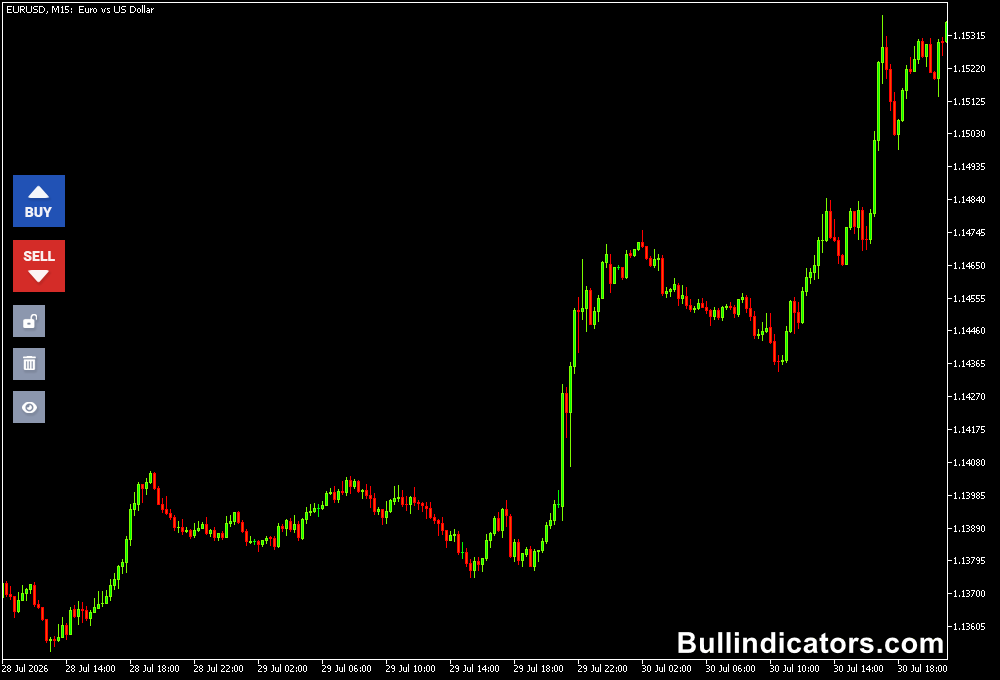
The tool places a position-planning area directly on the MT5 price chart.
The green section represents the potential profit area and the red section represents the potential loss area.
The entry, SL and TP levels can be adjusted using the chart controls, allowing the entire trade scenario to be assessed visually.
The displayed risk-reward ratio changes as the levels are moved.
This is particularly useful when price is approaching a support or resistance level and you need to determine whether there is enough room for a realistic target.
Core Features
- Displays projected profit and loss zones directly on the chart.
- Calculates the risk-reward ratio for the planned position.
- Allows SL and TP levels to be adjusted from the chart.
- Supports different position-volume units.
- Provides adjustable profit and loss colors.
- Includes background transparency controls.
Best for
- Planning trades before execution.
- Checking risk-reward ratios quickly.
- Setting precise stop-loss and take-profit levels.
- Managing short-term scalping positions.
- Testing whether a trade has sufficient price room before entry.
Best Markets
- EURUSD: Excellent for session-based scalping because of its high liquidity and typically tight spreads.
- GBPUSD: Useful during London and US sessions when intraday movement increases.
- USDJPY: Suitable for fast momentum setups around major session activity.
- Gold (XAUUSD): Useful when planning trades around larger intraday price swings.
Trading Styles
- M1-M5 scalping: Define a tight invalidation level and check the projected reward before entering.
- M15 intraday trading: Use recent swing highs and lows to establish realistic SL and TP levels.
- London session trading: Plan positions around breakouts and pullbacks as European liquidity increases.
- US session trading: Useful for managing setups created by New York momentum or continuation moves.
How traders use it
The tool works best as a trade-planning instrument rather than an entry-signal generator.
First identify the market direction and a valid technical setup using price action, support and resistance, or another strategy.
Then use the Long Short Position Tool to establish the entry, invalidation point and profit objective.
For a long trade, the stop-loss zone is positioned below the entry and the profit zone above it.
For a short position, these zones are reversed.
Moving the levels allows you to see how the risk-reward ratio changes before the position is opened.
For example, EURUSD can offer several opportunities during the London and US sessions when liquidity and volatility increase.
A simple M5 scalp could be planned around a London-session breakout followed by a retest.
- Market: EURUSD
- Session: London open/early US session
- Example quote: EURUSD trading at 1.1680
- Setup: Price breaks above 1.1680 resistance and retests the level as support.
- Entry: 1.1682 after bullish confirmation on the M5 chart.
- Stop loss: 1.1672, giving approximately 10 pips of risk.
- Take profit: 1.1702, providing approximately 20 pips of potential reward.
- Risk-reward: Approximately 1:2.
- Execution: Place the position tool on the chart and adjust the SL and TP zones to these levels before entering.
- Management: If EURUSD reaches the first resistance area quickly, reassess the position rather than automatically extending the target.
The same process can be used during the US session.
If price breaks a London high and holds above it, the tool can be used to define a new long setup.
For a bearish scenario, apply the same principles below a broken support level.
Get Instant Free Access
Indicator Settings
- Position Volume Units: Defines the unit used to measure trade volume, such as lots.
- Amount of Volume in Units: Sets the default position size for new trades.
- Step Volume Units: Determines the incremental amount used when adjusting position size.
- Units for TP and SL: Sets the measurement used for take-profit and stop-loss distances, including pips.
- Color Scheme: Controls the visual theme and the colors of the profit, loss and text areas.
- Background Transparency: Adjusts the transparency of the tool’s background.
Important Notes
- The indicator helps plan risk and reward but does not predict market direction.
- Always position the stop loss according to the trade’s technical invalidation point.
- During major economic releases, EURUSD can move rapidly and invalidate short-term setups.
- A high risk-reward ratio does not guarantee a profitable trade; the probability of reaching the target also matters.
- For scalping, account for spread and execution costs when calculating the realistic risk and reward.