The Chandelier Exit indicator for MT5 is a volatility-based trend-following tool designed to help identify directional moves while keeping positions open for as long as the trend remains intact.
It uses Average True Range (ATR) calculations to create dynamic levels that adapt to changing market volatility.
These levels have two main functions.
They can help identify potential entries when price crosses the Chandelier level, and they can act as a trailing reference for managing an existing position.
Because the distance of the levels changes with ATR, the stop does not remain fixed while market conditions change.
The indicator is particularly useful for trend-following strategies where exiting too early can significantly reduce the potential of a winning position.
It can be applied to Forex, indices, commodities and other liquid markets.
Why traders use the Chandelier Exit Indicator
Fixed stop-loss distances do not always adapt well to changing volatility.
A quiet market and a highly active market can require very different amounts of room for a position to develop.
The Chandelier Exit addresses this by using ATR to calculate its levels.
During an uptrend, the exit level generally remains below price, providing a dynamic reference for a long position.
During a downtrend, the level moves above price and can serve as a trailing reference for short positions.
This makes the indicator useful both for identifying direction and managing open trades.
Download This MT5 Indicator for Free
Indicator Chart Setup
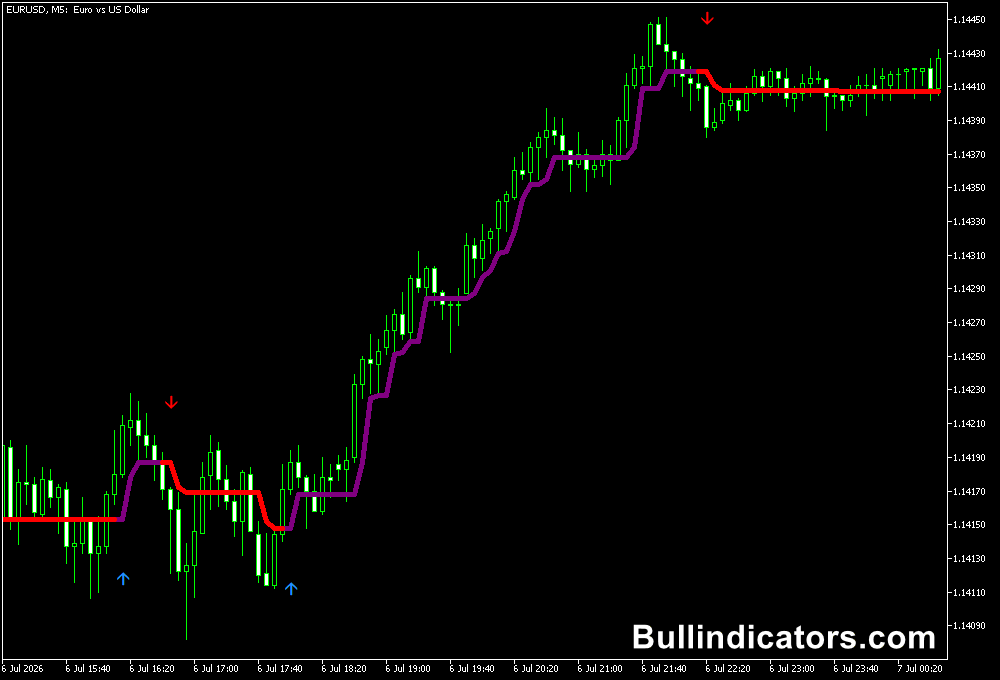
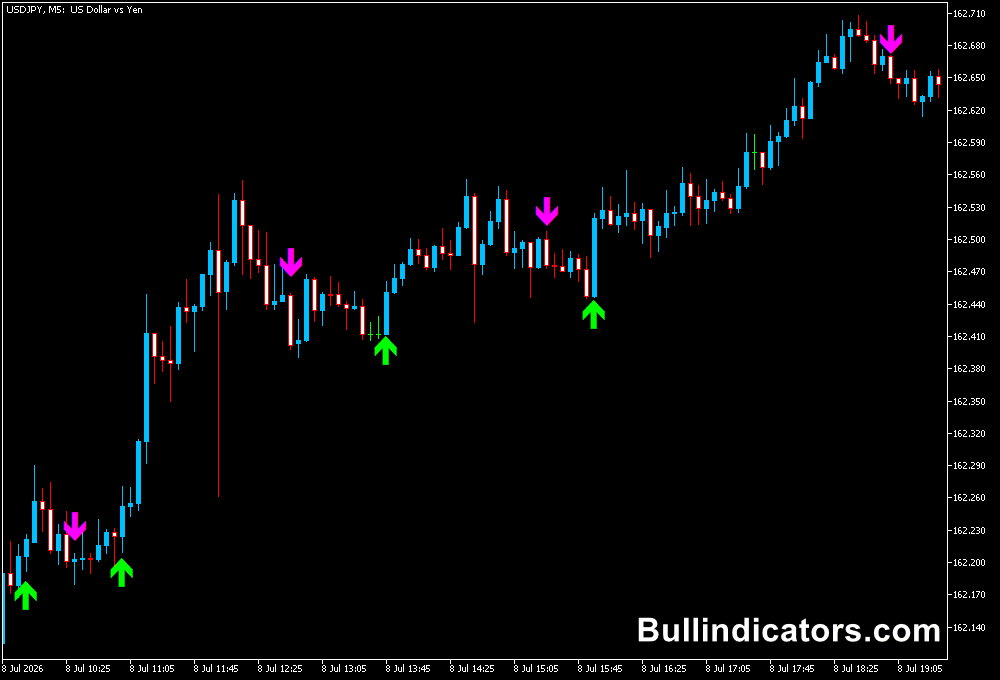
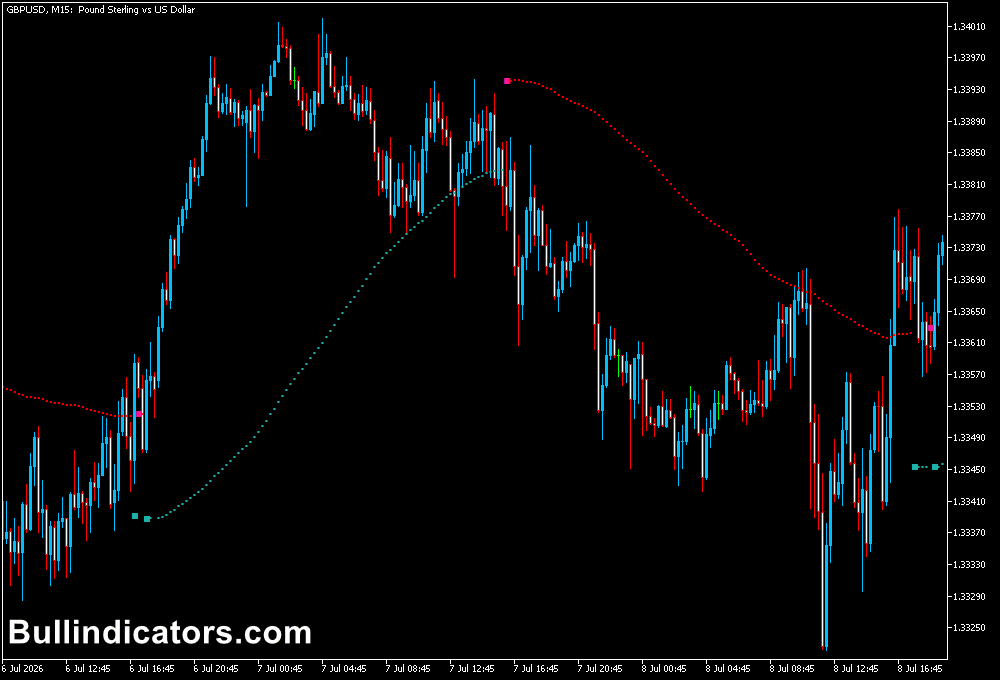
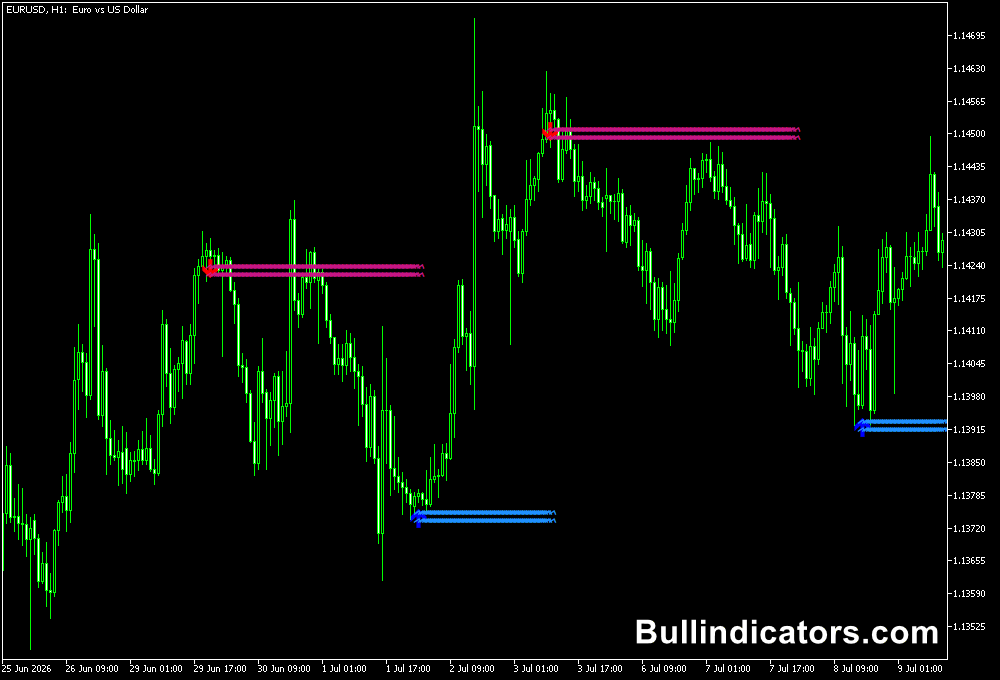
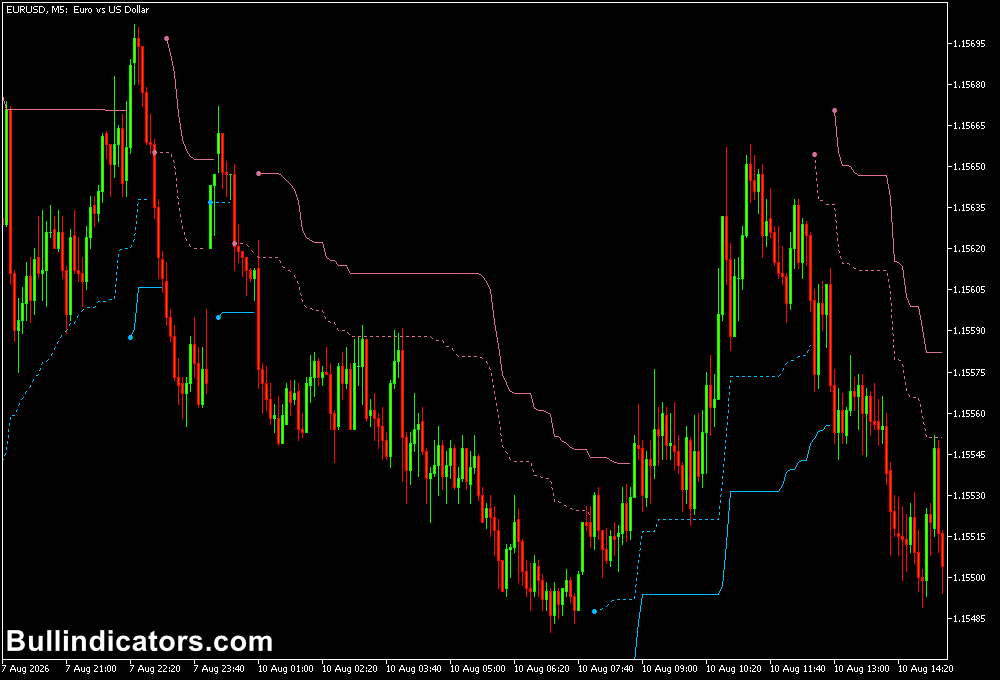
The Chandelier Exit plots dynamic levels directly around the price action.
When the market is bullish, the relevant level is positioned below price.
A bearish market places the level above price.
A move through the indicator can provide a potential directional signal.
However, a single crossover during a sideways period can be unreliable.
The strongest applications generally combine the Chandelier direction with market structure, volatility and a broader timeframe trend.
Core Features
- ATR-based dynamic trend and exit levels.
- Adapts stop distance to current market volatility.
- Provides potential crossover entry signals.
- Can function as a trailing stop reference.
- Helps maintain positions during sustained trends.
- Separate ATR multipliers allow the stop distance to be adjusted.
- Suitable for intraday and swing trading.
Best for
- Trend-following strategies.
- Dynamic stop-loss management.
- Reducing premature exits from profitable positions.
- Identifying directional changes after significant price breaks.
- Filtering entries with higher-timeframe trend confirmation.
Best Markets
- GBPUSD can work well on H1 and H4 when sustained directional moves develop.
- EURUSD is suitable for M15 and H1 trend-following because of its liquidity.
- USDJPY can provide useful setups during strong directional sessions.
- Gold can be considered on H1 and H4, although its higher volatility requires careful position sizing.
- Major indices can also suit the indicator when volatility produces extended directional movements.
Trading Styles
- M15 intraday trend trading after confirmed price breaks.
- H1 trend following on GBPUSD and EURUSD.
- H4 swing trading with the Chandelier level used as a trailing exit.
- Breakout trading when price crosses the level with strong momentum.
- Multi-timeframe trading using H4 for directional bias and M15 or H1 for execution.
How traders use it
A practical approach is to treat the Chandelier level as both a directional filter and a trade-management tool.
Rather than entering every time price briefly crosses the line, wait for evidence that the market has actually changed direction.
How to Reduce False Setups
- Start by checking the H1 or H4 chart to determine the dominant market direction.
- Only consider long signals when the higher timeframe supports bullish conditions.
- For short positions, look for a declining higher-timeframe trend.
- Wait for a candle to close beyond the Chandelier level rather than reacting to a temporary intrabar penetration.
- Check whether the breakout is accompanied by a meaningful price move rather than a small candle inside a tight range.
- Avoid taking crossover signals when the Chandelier level is repeatedly switching sides around flat price action.
- Use a nearby support or resistance zone to determine whether there is enough room for the trade to develop.
Practical GBPUSD H1 Buy Example
Suppose GBPUSD is already making higher highs and higher lows on H1.
The Chandelier Exit remains below price, confirming the bullish environment.
After a controlled pullback, GBPUSD breaks above a recent swing high and closes clearly above the Chandelier level.
- H4 and H1 price action show a bullish bias.
- The Chandelier level remains below GBPUSD.
- A pullback forms without breaking the broader bullish structure.
- An H1 candle closes above the recent swing high.
- The long entry is taken after the breakout rather than during the pullback.
- The initial stop can be positioned below the latest meaningful swing low.
- As the trend develops, the Chandelier level can be followed as a dynamic trailing stop.
This approach helps avoid buying simply because price briefly moves above the indicator.
Requiring a candle close, a higher-timeframe bias and a break of market structure can remove many weak crossover signals.
Practical GBPUSD H1 Sell Example
For a short setup, assume GBPUSD is making lower highs and lower lows.
The Chandelier level is positioned above price.
Following a temporary upward retracement, the pair turns lower and an H1 candle closes beneath a recent support area while the indicator remains bearish.
- The higher timeframe supports a declining market.
- The Chandelier level stays above price.
- GBPUSD retraces toward resistance without breaking the bearish structure.
- Price then closes below the recent H1 support level.
- A short entry can be considered after the bearish breakout.
- Place the initial stop above the latest relevant swing high.
- Allow the Chandelier level to trail the position as the decline continues.
Get Instant Free Access
Indicator Settings
- ATR Period – determines the ATR calculation period used by the Chandelier Exit.
- ATR 1st Multiple – adjusts the first ATR-based distance used for the indicator level.
- ATR 2nd Multiple – controls the second ATR multiplier and corresponding stop distance.
Important Notes
- The indicator is most effective when the market is producing sustained directional movement.
- Repeated crossovers can occur during sideways conditions and should be treated cautiously.
- ATR-based levels expand when volatility increases and contract when market activity decreases.
- A candle-close confirmation can help filter temporary price spikes through the indicator.
- The Chandelier level can be used as a trailing reference, but risk should still be defined before entering the trade.