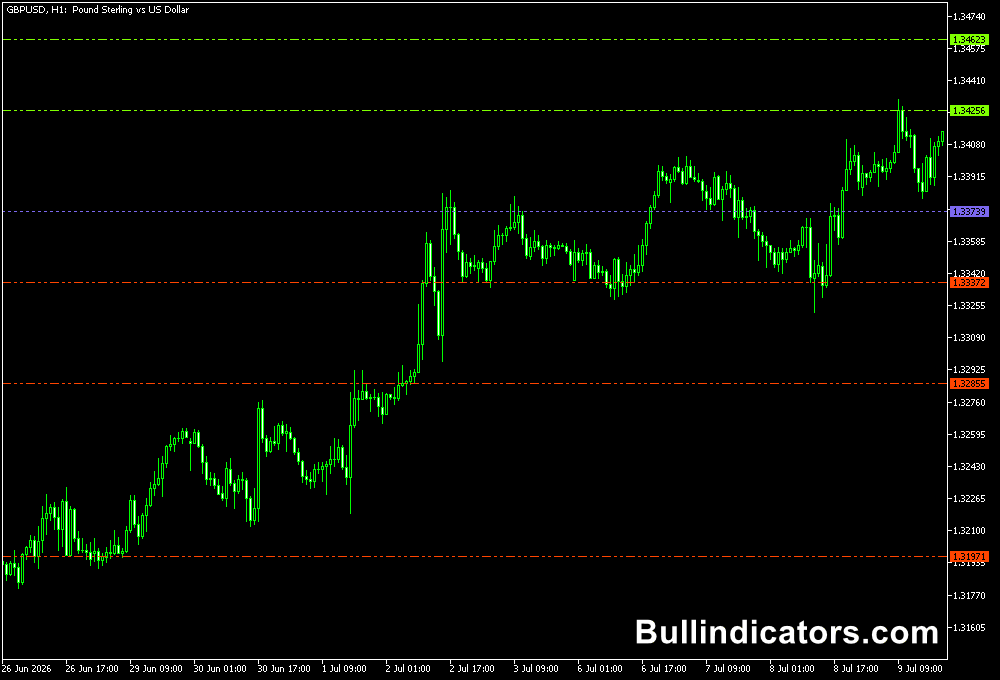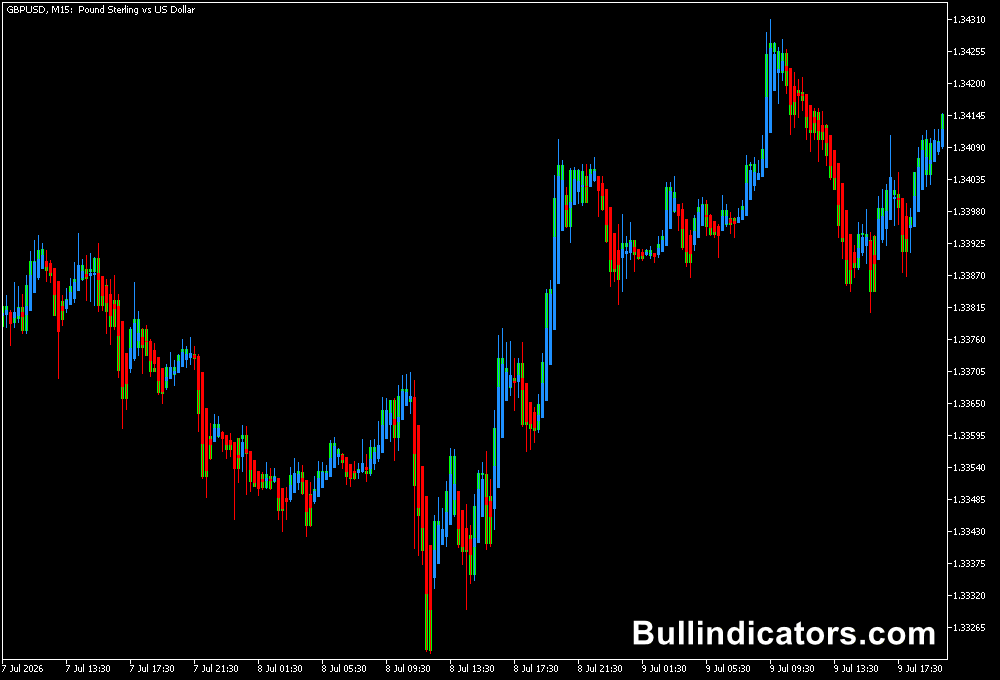
The EMA Indicator for MT5 is a versatile trend-following tool based on the Exponential Moving Average.
Unlike a simple moving average, the EMA gives greater weight to recent price data, allowing it to react faster when market conditions change.
An EMA can be used to identify the prevailing direction, locate dynamic support and resistance, and build crossover systems.
Shorter periods respond quickly to new price movement and are useful for intraday trading, while longer periods provide a broader view of the market trend.
The indicator can be applied to virtually any MT5 instrument and timeframe, making it suitable for everything from M1 scalping to H4 and D1 trend analysis.
Why traders use the EMA Indicator
The position and slope of an EMA provide two simple pieces of information.
When the line is rising, bullish pressure is increasing, while a declining EMA indicates a bearish environment.
Price trading above the EMA generally supports a bullish bias, whereas price below the line favors bearish conditions.
The EMA becomes more powerful when several periods are combined. A fast EMA can identify short-term momentum, while a slower EMA provides the broader trend filter.
Their crossover can then be used as an entry trigger.
Another practical application is using the EMA as dynamic support or resistance.
During a strong trend, price often pulls back toward a moving average before continuing in the original direction.
This allows the EMA to become part of both entry and trade-management decisions.
Download This MT5 Indicator for Free
Indicator Chart Setup
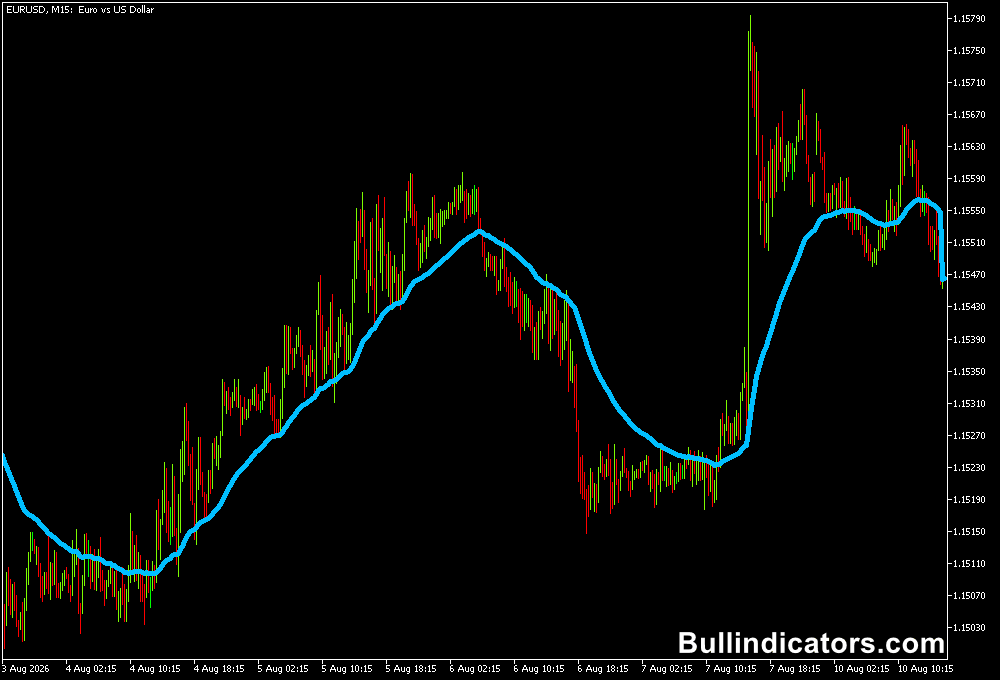
The EMA is displayed directly over the MT5 price chart as a moving average line.
The selected period determines how quickly the line responds to price changes.
A short EMA stays closer to price and reacts quickly, while a longer EMA moves more gradually and provides a broader trend reference.
Multiple instances can be placed on the same chart to create a crossover system.
For example, a 9 EMA and 21 EMA can be used for shorter-term trend changes, while a 200 EMA can provide the main market-direction filter.
Core Features
- Exponential moving average calculation with greater weighting toward recent prices.
- Identifies the current directional bias through EMA slope and price position.
- Can be used as dynamic support or resistance.
- Supports fast and slow EMA crossover strategies.
- Suitable for single, dual or multiple EMA systems.
- Can be applied to Forex, gold, indices, stocks, cryptocurrencies and other MT5 markets.
- Works across short-term and higher timeframes.
Best for
- Filtering trades according to the prevailing market direction.
- Finding trend continuation entries after price retraces toward the EMA.
- Building crossover systems with fast and slow averages.
- Using a longer EMA as a broader trend filter.
- Tracking momentum changes on intraday charts.
Best Markets
- EURUSD: Effective for fast EMA systems during London and New York trading.
- GBPJPY: Useful for momentum-based setups when the pair develops strong intraday trends.
- XAUUSD: Suitable for M5 and M15 crossover strategies during periods of elevated volatility.
- US30 and NASDAQ: Longer EMAs can help filter the direction of strong session moves.
- BTCUSD: EMA relationships can be used to track extended directional movements in a highly active market.
- Major and minor currency pairs: The same principles can be adapted to different volatility profiles by adjusting the periods.
Trading Styles
- M5 scalping: Fast EMA combinations can identify short-term momentum on EURUSD, GBPUSD or gold.
- M15 intraday trading: EMA crossovers can be combined with price-action confirmation on EURUSD, USDJPY or XAUUSD.
- Trend following: H1 and H4 charts allow slower EMAs to filter short-term market noise.
- Breakout trading: A strong move through a longer EMA can help confirm a change in directional conditions.
- Pullback trading: M15 and H1 traders can wait for price to return to a rising or falling EMA before looking for continuation.
How traders use it
One of the most common applications is the fast-and-slow EMA crossover.
A 9-period EMA and 21-period EMA provide a practical combination for short-term trading.
The faster average reacts first when momentum changes, while the slower average provides a reference for the broader short-term direction.
EMA Crossover Example: EURUSD M5 and M15
On EURUSD, the 9 EMA can be combined with the 21 EMA on M5 or M15.
The M15 chart can be used to establish the broader intraday direction, while M5 provides the entry.
- BUY: The 9 EMA crosses above the 21 EMA and both averages begin turning upward.
- BUY confirmation: Price remains above the crossover area and preferably breaks a recent M5 or M15 swing high.
- BUY stop loss: Place the stop below the recent pullback low or below a relevant support zone.
- BUY exit: Target the next resistance area or manage the position toward a 1:2 or 1:3 risk-to-reward objective.
- SELL: The 9 EMA crosses below the 21 EMA while both averages begin turning downward.
- SELL confirmation: Price remains below the crossover and breaks a recent swing low.
- SELL stop loss: Place the stop above the latest pullback high or nearby resistance.
- SELL exit: Target the next support zone or use a predefined risk-to-reward target.
EMA Example: Gold on M5
For XAUUSD scalping, a faster EMA combination can respond to the metal’s frequent intraday momentum changes.
For example, the 5 EMA and 15 EMA can be used on M5, while a 200 EMA provides a broader directional filter.
- BUY: Price is above the 200 EMA and the 5 EMA crosses above the 15 EMA.
- Confirmation: The crossover occurs after a pullback and price breaks the recent M5 high.
- SELL: Price is below the 200 EMA and the 5 EMA crosses below the 15 EMA.
- Confirmation: Bearish momentum returns after a pullback and price breaks the recent M5 low.
The 200 EMA can also act as an important dynamic market level.
When price repeatedly crosses it, conditions may be too indecisive for a straightforward trend strategy.
Stronger setups generally occur when the averages are separated and clearly sloping.
EMA systems can also be expanded into a triple-average approach.
A 5, 15 and 200 EMA combination gives the short-term momentum, intermediate direction and long-term trend filter separate roles.
This can reduce the number of trades while keeping the strategy focused on directional markets.
Get Instant Free Access
Indicator Settings
- Period: Determines the number of candles included in the EMA calculation. Lower values react faster to price changes, while higher values produce a slower and smoother average.
- Colors: Allows the visual color of the EMA line to be configured according to the chart setup.
- Style: Controls the appearance of the EMA line on the MT5 chart.
Important Notes
- Short EMA periods react quickly but can generate more signals during choppy markets.
- Longer periods provide a broader trend reference but can react later to major reversals.
- A crossover is more useful when supported by price structure, momentum or a clear market trend.
- Repeated EMA crossings around a flat market often indicate poor trend conditions.
- The same EMA strategy can behave very differently on M5, H1 and D1 charts.
- Periods should be tested on the specific instrument because volatility varies between Forex, metals, indices and cryptocurrencies.