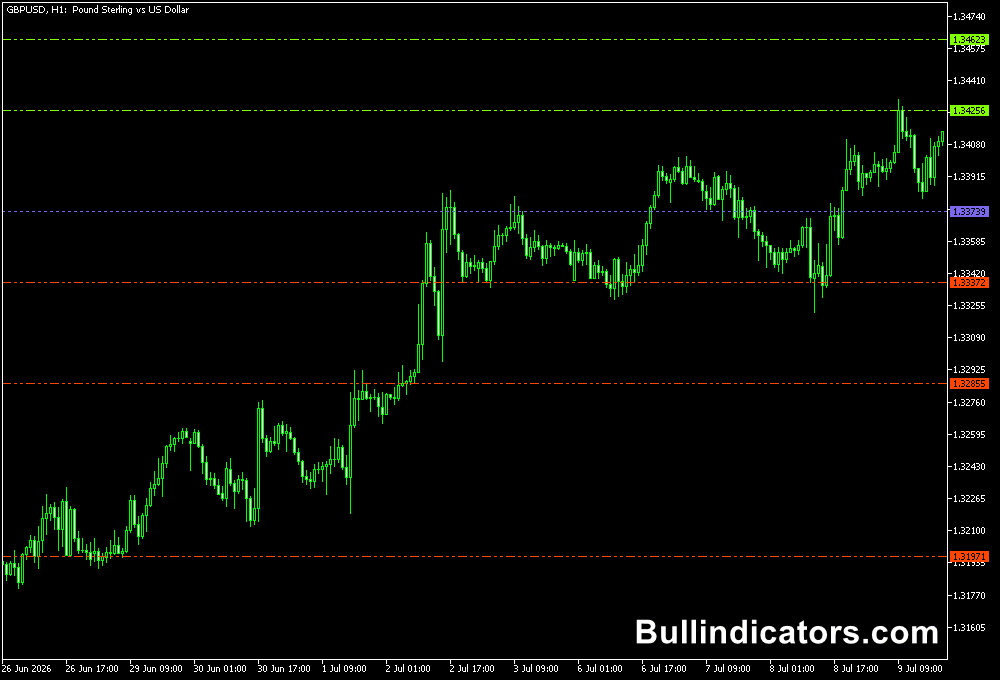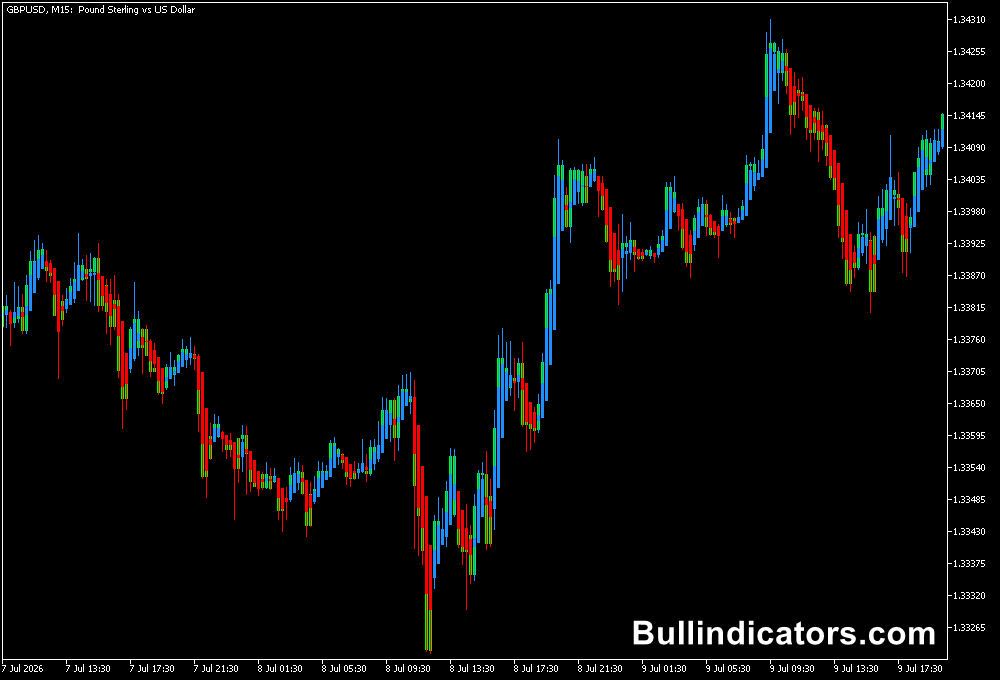
The TD Sequential Ultimate indicator for MT5 automates the well-known Tom DeMark sequential counting method directly on the price chart.
It analyzes consecutive price bars and marks them with numerical sequences, helping identify areas where an established move may be losing momentum.
The method can be applied to Forex, indices, commodities and other assets available through MetaTrader 5.
The indicator is particularly useful for studying potential exhaustion points.
Numbers appearing during an advancing or declining market allow users to monitor the development of a sequence without manually counting candles.
The later stages of the sequence can highlight areas where a reversal or corrective movement deserves closer attention.
Why traders use TD Sequential Ultimate
Manually applying the TD Sequential method requires consistent candle counting and comparison of highs and lows.
TD Sequential Ultimate handles this process automatically and places the relevant numbers and signals directly on the chart.
The indicator can be useful for both reversal analysis and timing entries after a trend has shown signs of exhaustion.
It can also be combined with support and resistance, swing highs and lows, trend lines and higher-timeframe price structure to filter potential setups.
Download This MT5 Indicator for Free
Indicator Chart Setup
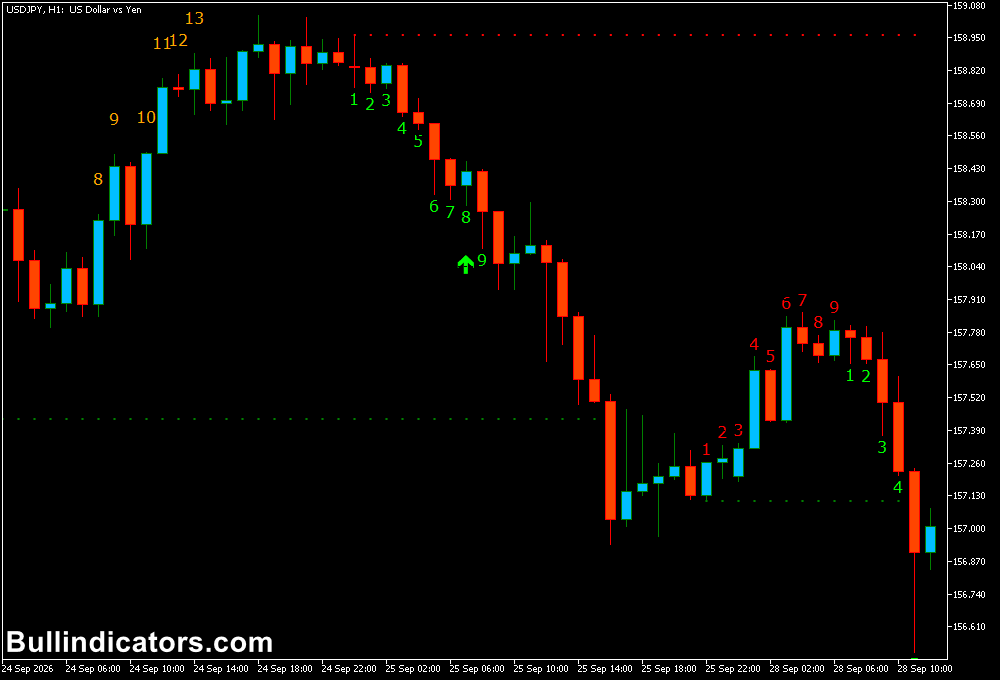
Sequential numbers are placed around the candlesticks as the required price sequence develops.
Buy and sell setup colors, countdown numbers and arrows can be customized from the input settings.
A typical sequence progresses through numbered candles, with the later numbers drawing attention to potential exhaustion.
The indicator can therefore be monitored alongside the actual price action to determine whether the market is approaching an area where momentum may weaken.
Core Features
- Automatic TD Sequential candle counting
- Buy and sell setup identification
- Countdown display
- Customizable setup and countdown colors
- Adjustable arrow size and chart positioning
- Custom font type and font size
- Configurable alert options
- Suitable for multiple asset classes and timeframes
Best for
- Identifying potential trend exhaustion
- Studying reversal zones after extended price movements
- Timing entries following a completed setup
- Combining sequential signals with price action analysis
- Multi-timeframe reversal analysis
Best Markets
- EURUSD and GBPUSD for intraday reversal setups around established support and resistance.
- GBPJPY for larger momentum swings where sequential exhaustion can develop after an extended move.
- USDJPY for session-based reversal analysis on M15 and H1.
- XAUUSD for studying extended directional moves on M15, H1 and H4.
- Major stock indices can also be analyzed when the broker provides them through MT5.
Trading Styles
- Scalping on M1 and M5 after a sequential setup develops near a key price level.
- Intraday reversal trading on M5 and M15.
- Short-term swing entries on H1 and H4.
- Multi-timeframe analysis using H1 or H4 for market structure and M5 or M15 for execution.
How traders use it
The indicator can be used by waiting for a completed sequence and then examining the price action around the setup.
A numbered sequence alone does not guarantee an immediate reversal.
A stronger setup occurs when sequential exhaustion appears close to an established support or resistance zone and the following candle confirms a change in direction.
For scalping, the M1/M5 chart can provide a practical balance between signal frequency and price movement.
The following examples show how a sequential setup can be incorporated into a short-term plan.
Buy Scalping Example
- Open EURUSD on the M5 chart and identify an established downward move.
- Wait for the TD Sequential numbers to progress toward the later stages of the setup.
- Look for the setup to develop close to a previously tested support level or intraday low.
- When the required bearish sequence completes, do not enter solely because the final number appears.
- Wait for a bullish confirmation candle, such as a strong bullish close or a break above the previous candle’s high.
- Enter the buy position after confirmation.
- Place the stop loss below the recent swing low or support zone.
- For a 5–15 pip scalp, the first target can be a nearby resistance level or a predefined pip objective.
- If EURUSD moves 12 pips upward and reaches resistance, the position can be closed for a 12-pip gain.
Sell Scalping Example
- Open GBPUSD on the M5 chart after a sustained upward move has developed.
- Look for the sequential count to progress toward the later stages of the setup.
- Give greater attention to a setup forming near resistance, a previous high or a clear intraday supply area.
- Wait for the bearish sequence to complete and then look for confirmation from price action.
- A bearish candle closing below the previous candle’s low can confirm a short entry.
- Place the stop loss above the recent swing high.
- Set the initial target around 5–15 pips or use the next support area as the exit reference.
- For example, a 9-pip decline can provide a small scalp before price reaches nearby support.
- If price moves back above the setup high and triggers the stop, the loss remains limited by the predefined risk.
Get Instant Free Access
Indicator Settings
- BuySetupColor: Selects the color used for buy setups.
- SellSetupColor: Selects the color used for sell setups.
- CountdownColor: Controls the color of the countdown numbers.
- FontFace: Selects the font used for the numerical labels.
- FontSize: Sets the size of the numbers displayed on the chart.
- ArrowWidth: Controls the size of the indicator arrows.
- PixelDistance: Adjusts the distance between the indicator markings and candlesticks.
- Prefix: Adds a custom prefix to the indicator objects displayed on the chart.
- Alert options: Enables or disables the available indicator alerts.
Important Notes
- A completed TD Sequential setup identifies a potential exhaustion area rather than guaranteeing an immediate reversal.
- Price action confirmation can help distinguish genuine reversals from temporary pauses in a strong trend.
- For scalping, nearby support and resistance should be considered before selecting a profit target.
- Lower timeframes generate more frequent setups and can contain greater market noise.
- Stop-loss placement should be based on the recent market structure and the volatility of the selected asset.
- Test the indicator on the chosen market and timeframe before using it with live capital.